
Small · Sortable · Secure ID generator

pikaid is the official Ruby implementation of a compact, chronologically sortable, collision-resistant identifier format for databases, APIs, and distributed systems.
This is the immutable, unversioned pikaid format, documented in specification revision 1.0.4.
✨ Why pikaid?
- Short: Compact, readable IDs for URLs, logs, and API resources.
- Sortable: Lexicographically ordered by timestamp, with one-second precision.
- Collision-resistant: 96 bits of cryptographic randomness make collisions extremely unlikely, never impossible.
-
Storage-friendly: Use
BINARY(17)or readableCHAR(26). - Distributed-friendly: No central sequence generator or coordination required.
🧬 Identifier format
A pikaid contains 26 lowercase Base36 characters: a 7-character Unix-seconds timestamp followed by 19 characters encoding 96 bits of cryptographic randomness. Its binary form is 17 bytes: 5 unsigned big-endian timestamp bytes followed by 12 randomness bytes.
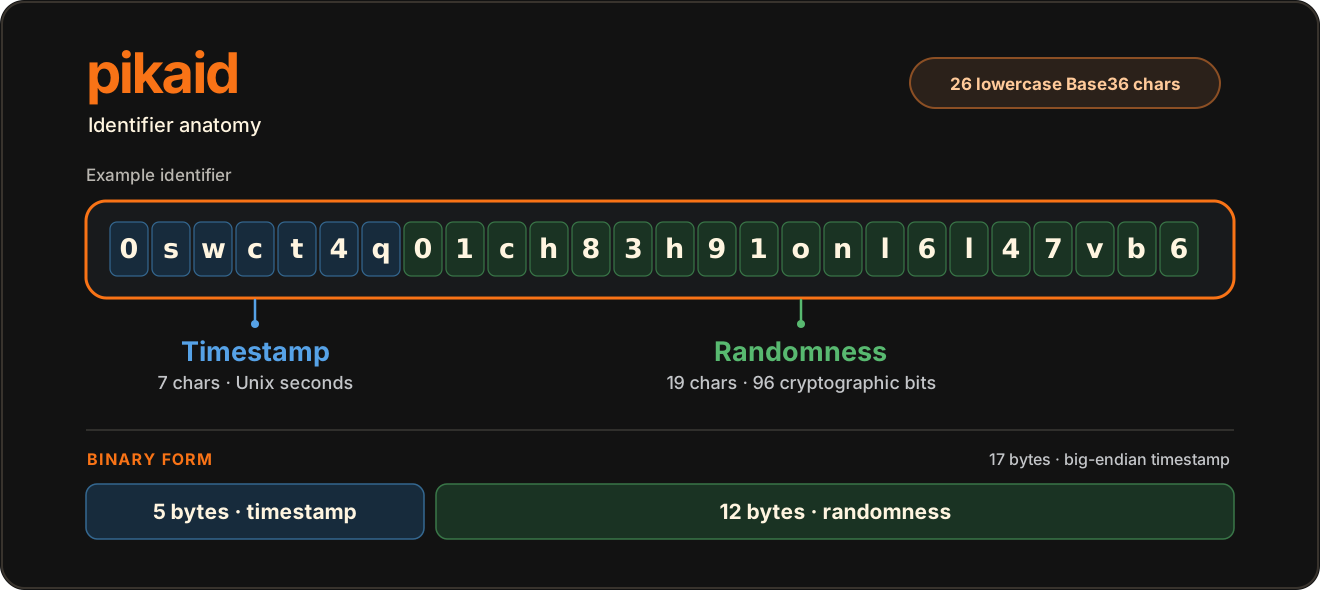
Ordering: Different seconds sort chronologically. Within the same second, randomness—not issuance order—decides the order.
Security: These are identifiers, not secrets, session credentials, authentication tokens, or API keys.
⚙️ Requirements
- Ruby 2.6 or newer (
required_ruby_version >= 2.6.0). - No runtime dependencies beyond the Ruby standard library
(
securerandomis the only cryptographic dependency).
Support policy
Version 1.0.0 declares MRI/YARV 2.6 through 4.0 and is verified on every
minor line from 2.6 to 4.0. Ruby 2.6 and 2.7 are end-of-life upstream: they
remain in the declared range, in CI, and in the verification matrix because the
gemspec still accepts them, but they are compatibility-only and no newer
language features are used. Ruby 4.0 is the newest stable line; preview and RC
releases are not supported.
The full native suite and the pinned official adapter were executed on Linux
containers for Ruby 2.6.10, 2.7.8, 3.0.7, 3.1.7, 3.2.11, 3.3.13, 3.4.12, and
4.0.9; the host macOS run used Ruby 2.6.10. The push-triggered GitHub Actions
workflow is configured to test Ruby 2.6 on ubuntu-22.04, Ruby 2.7 through 4.0
on ubuntu-latest, and Ruby 4.0 on macos-latest and windows-latest. A
separate job installs the built gem into an isolated GEM_HOME and exercises
it from a consumer script, and verifies the packaged file inventory, so
packaging regressions are caught outside the checkout.
📦 Installation
Version 1.0.0 is prepared but the gem is not published to RubyGems yet, so
gem install pikaid does not apply. Install it from source:
git clone https://github.com/pikaid/pikaid-ruby.git
cd pikaid-ruby
bundle install
bundle exec rake test
To build and install a local gem:
gem build pikaid.gemspec
gem install ./pikaid-1.0.0.gem
The built package contains only lib/**/*.rb, README.md, LICENSE, and
CHANGELOG.md. Local .ai/ workspace artifacts, tests, CI configuration, and
build leftovers are never packaged.
🚀 Basic Usage
After installing the local gem, save the following as demo.rb and execute ruby demo.rb:
require "pikaid"

id = Pikaid.generate
parsed = Pikaid.parse(id)
bytes = parsed.to_binary
raise "Invalid identifier" unless Pikaid.valid?(id)
raise "Binary round-trip failed" unless Pikaid.from_binary(bytes) == parsed
puts "#{id} @ #{parsed.timestamp}"
💡 Example Use Case
Use pikaid to identify users, orders, invoices, uploads, events, and API resources. Independent services can generate compact IDs without a shared counter, while timestamp-based ordering helps with indexing, sorting, and logs.
📚 Canonical specification
Specification revisions describe the format; they do not change the encoded identifiers.
🧩 API Reference
require "pikaid"

# Generate using the current whole second.
id = Pikaid.generate            #=> "0s44we8..." (26 characters)
id.class                        #=> String
id.bytesize                     #=> 26

# Generate with an explicit Unix timestamp (whole seconds).
Pikaid.generate(timestamp: 1_700_000_000)   #=> 26-character String

# Generate the 17-byte binary form directly.
Pikaid.generate_binary(timestamp: 1_700_000_000).bytesize  #=> 17

# Parse and decode.
parsed = Pikaid.parse("0s44we8002loz3po6mcf6vsn23")
parsed.timestamp        #=> 1700000000
parsed.randomness       #=> "\x00\x11\"3DUfw\x88\x99\xAA\xBB"
parsed.randomness_hex   #=> "00112233445566778899aabb"
parsed.entropy          #=> same bytes as #randomness
parsed.to_s             #=> "0s44we8002loz3po6mcf6vsn23"
parsed.to_binary.bytesize  #=> 17
parsed.to_binary.unpack("H*")[0]
#=> "006553f10000112233445566778899aabb"

# Pikaid stores whole Unix seconds, not a timezone. Time.at(...).utc is the
# explicit UTC conversion; no timezone is implied by the identifier itself.
Time.at(parsed.timestamp).utc.strftime("%Y-%m-%dT%H:%M:%SZ")
#=> "2023-11-14T22:13:20Z"

# Binary round trip.
Pikaid.from_binary(parsed.to_binary) == parsed   #=> true

# Strict validation.
Pikaid.valid?("0s44we8002loz3po6mcf6vsn23")      #=> true
Pikaid.valid_binary?(parsed.to_binary)           #=> true
Pikaid.well_formed?("0000000zzzzzzzzzzzzzzzzzzz") #=> true (shape only)
Pikaid.valid?("0000000zzzzzzzzzzzzzzzzzzz")       #=> false (96-bit overflow)

# Helper functions accept either a String or a Pikaid::Id.
Pikaid.timestamp(parsed)                 #=> 1700000000
Pikaid.randomness(parsed)          #=> 12-byte String
Pikaid.decode(parsed)                    #=> [1700000000, "..."]
Pikaid.to_binary(parsed)                 #=> 17-byte String
Pikaid.compare(parsed, parsed)       #=> -1, 0, or 1
Errors
All errors inherit from Pikaid::Error:
begin
  Pikaid.parse("not-a-pikaid")
rescue Pikaid::InvalidIdError => error
  error.reason  #=> :invalid_string_length or :invalid_character, ...
  error.value   #=> the rejected input
end-
Pikaid::InvalidIdError— text or binary input is not a valid pikaid. -
Pikaid::InvalidTimestampError— a supplied timestamp is negative, out of range, or not an Integer. -
Pikaid::RandomnessError— the cryptographic source failed or returned the wrong number of bytes. Generation fails closed; there is no fallback.
🔄 Order Guarantee
- Canonical bytewise/ASCII lexicographic order is chronological across different seconds.
- Identifiers generated within the same second are not monotonic. Their order is determined by their random suffix, not by generation time.
- The timestamp has whole-second precision only; there is no sub-second ordering guarantee.
- Randomness comes from
SecureRandom.random_bytes(12). pikaid is not an authentication token, does not provide secrecy, and does not guarantee uniqueness. Treat it as a compact, sortable identifier, not as a capability or a security credential.
🛢 Storage Recommendations
| Representation | Size | Recommended for |
|---|---|---|
| BINARY(17) | 17 bytes | Compact primary keys and indexes |
| CHAR(26) | 26 characters | Readable SQL, debugging, URLs, and logs |
Use an ASCII bytewise/binary collation for text columns (for example, ascii_bin on MariaDB/MySQL). Case-insensitive or locale-aware sorting is not a substitute for canonical bytewise comparison.
✅ Verification and release status
The CI workflow runs native tests, pinned automated conformance checks, and language-specific quality gates. To run the native checks locally from a checkout, use bundle exec rake test.
Automated passing tests are not a security certification. The independent CSPRNG source and failure-path audits (P-GENERATE-RNG-SOURCE and P-GENERATE-RNG-FAILURE) still require separate human evidence.
bundle exec rake syntax    # ruby -c over lib, test, Rakefile, gemspec
bundle exec rake test      # Minitest suite
bundle exec rake coverage  # stdlib line coverage; fails below 90%
gem build pikaid.gemspec   # build the gem
The test suite covers every official PHP v1.2.0 vector, specification known-answer cases, malformed and overflow inputs, boundary values, randomized round trips against an independent oracle, generated-ID sanity checks, and cryptographic failure paths.
The official cross-language suite is
pikaid-specs 1.0.0,
pinned to the immutable commit 059780cc0e5b113443812720d95c630649bf3aa3
(specification revision 1.0.4). test/support/official_adapter.rb is a
test-only JSON-Lines bridge: every operation calls the real public Pikaid
API, the file is not packaged in the gem, and it advertises only capabilities
the library genuinely provides. parse_datetime is omitted because the Ruby
API exposes whole-second timestamps rather than a datetime accessor.
# Run from the pinned suite's conformance/ directory.
python tools/run_adapter.py --automated-only \
  -- ruby -I/path/to/pikaid-ruby/lib /path/to/pikaid-ruby/test/support/official_adapter.rb
An --automated-only run exiting 0 means the automated checks passed. It is
not a conformance or security certification. A default run (without
--automated-only) exits 3 while the two manual CSPRNG review obligations,
P-GENERATE-RNG-SOURCE and P-GENERATE-RNG-FAILURE, remain outstanding.
Those require independent human review of the entropy source and of the
failure path, and no automated run can satisfy them. The
Official conformance (pinned suite) CI job executes the automated subset
only.
Registry publication is not implied by a green CI: use the installation method documented above.
🤝 Contributing
Contributions are always welcome! 💙
Whether you're fixing a typo, improving documentation, adding tests, or making pikaid even better, every contribution is appreciated.
Want to help? Here's how:
- 🐛 Found a bug? Open an issue with clear reproduction steps.
- 💡 Have an idea? Start with an issue before making major changes.
- 🛠️ Ready to contribute? Open a pull request explaining your changes.
- 🧪 Keep it tested. Add meaningful regression tests for behavior changes and follow the existing conventions.
- ✅ Make sure CI passes. All required checks must be green before a pull request is merged. No shortcuts!
One important rule: pikaid's identifier format is immutable. Contributions must preserve the canonical specification (revision 1.0.4).
🔐 Found a security vulnerability? Report it privately using GitHub's security reporting (when available), or contact the maintainer—not through a public issue.
Every improvement matters, big or small. Thanks for helping make pikaid better! 🐇
📄 License
The implementation is available under the MIT License.
✉️ Contact
For licensing or project-related questions: larananas.dev@proton.me.