
Seccomp Tools
Powerful tools for seccomp analysis.
This project is aimed primarily (but not exclusively) at analyzing seccomp sandboxes in CTF pwn challenges. Some features are CTF-specific, but they're just as useful for analyzing real-world seccomp filters.
Features
- Dump - Automatically dumps seccomp BPF from executables.
- Disasm - Converts seccomp BPF to a human-readable format.
- With simple decompilation.
- With syscall names and arguments whenever possible.
- Colorful!
- Asm - Makes writing seccomp rules as easy as writing code.
- Emu - Emulates seccomp rules.
- Explain - Summarizes a filter as a per-action policy (which syscalls are allowed/killed, and when).
- Audit - Scans a filter for weaknesses and escape routes (missing arch/x32 guards, dangerous syscalls, ...).
- Multi-architecture support.
Installation
Available on RubyGems.org!
$ gem install seccomp-tools
If compilation fails, try:
sudo apt install gcc ruby-dev make
then install seccomp-tools again.
Command Line Interface
seccomp-tools
$ seccomp-tools --help
# Usage: seccomp-tools [--version] [--help] <command> [<options>]
#
# List of commands:
#
# 	asm	Seccomp bpf assembler.
# 	audit	Assess a seccomp filter for weaknesses and escape routes.
# 	completion	Print a shell completion script.
# 	disasm	Disassemble seccomp bpf.
# 	dump	Automatically dump seccomp bpf from executable(s).
# 	emu	Emulate seccomp rules.
# 	explain	Summarize a seccomp filter as a per-action policy.
#
# See 'seccomp-tools <command> --help' to read about a specific subcommand.

$ seccomp-tools dump --help
# dump - Automatically dump seccomp bpf from executable(s).
# NOTE: This command is only available on Linux.
#
# Usage: seccomp-tools dump [EXEC] [options]
#     -c, --sh-exec <command>          Executes the given command (via sh) and dumps its seccomp.
#                                      Use this to pass arguments or pipe things to the executable.
#                                      e.g. use `-c "./bin > /dev/null"` to keep the program output out of the result.
#                                      Takes precedence over the positional argument.
#     -l, --limit LIMIT                Dump only the first LIMIT installed filters.
#                                      Only meaningful when the input is an executable or --pid. Default: 1
#                                      An executable is killed once it reaches LIMIT.
#     -p, --pid PID                    Dump the seccomp filters installed on an existing process.
#                                      You must have CAP_SYS_ADMIN (e.g. be root) to use this option.
#     -t, --timeout SEC                Timeout (seconds) for the execution. Default: no timeout
#                                      This option is ignored when --pid is given.
#     -f, --format FORMAT              Output format. FORMAT can only be one of <disasm|raw|inspect>.
#                                      Default: disasm
#     -o, --output FILE                Write output to FILE instead of stdout.
#                                      If multiple seccomp syscalls have been invoked (see --limit),
#                                      results are written to FILE, FILE_1, FILE_2, etc.
#                                      For example, with "--output out.bpf" the output files are out.bpf, out_1.bpf, ...
dump
Dumps the seccomp BPF from an executable, using the ptrace syscall.
NOTE: the target executable is actually run, so be careful with untrusted binaries.
$ file spec/binary/twctf-2016-diary
# spec/binary/twctf-2016-diary: ELF 64-bit LSB executable, x86-64, version 1 (SYSV), dynamically linked, interpreter /lib64/ld-linux-x86-64.so.2, for GNU/Linux 2.6.24, BuildID[sha1]=3648e29153ac0259a0b7c3e25537a5334f50107f, not stripped

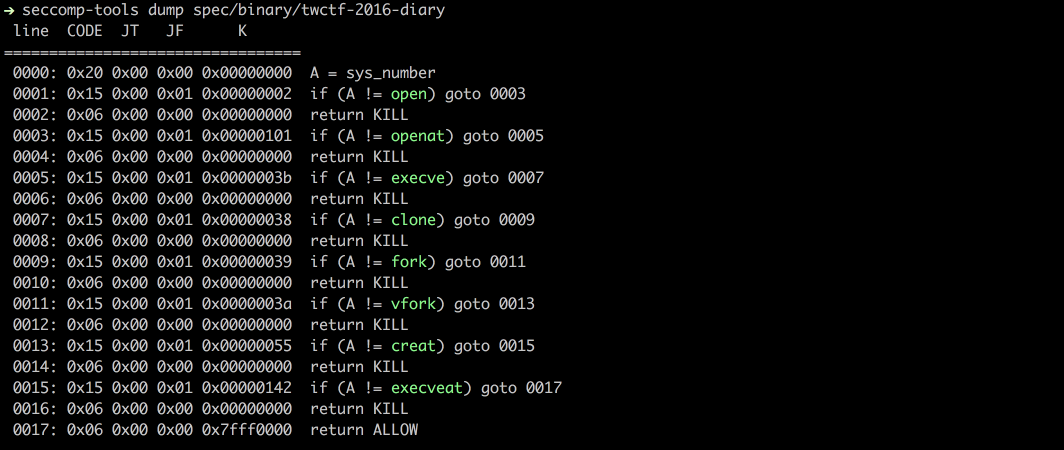
$ seccomp-tools dump spec/binary/twctf-2016-diary
#  line  CODE  JT   JF      K
# =================================
#  0000: 0x20 0x00 0x00 0x00000000  A = sys_number
#  0001: 0x15 0x00 0x01 0x00000002  if (A != open) goto 0003
#  0002: 0x06 0x00 0x00 0x00000000  return KILL
#  0003: 0x15 0x00 0x01 0x00000101  if (A != openat) goto 0005
#  0004: 0x06 0x00 0x00 0x00000000  return KILL
#  0005: 0x15 0x00 0x01 0x0000003b  if (A != execve) goto 0007
#  0006: 0x06 0x00 0x00 0x00000000  return KILL
#  0007: 0x15 0x00 0x01 0x00000038  if (A != clone) goto 0009
#  0008: 0x06 0x00 0x00 0x00000000  return KILL
#  0009: 0x15 0x00 0x01 0x00000039  if (A != fork) goto 0011
#  0010: 0x06 0x00 0x00 0x00000000  return KILL
#  0011: 0x15 0x00 0x01 0x0000003a  if (A != vfork) goto 0013
#  0012: 0x06 0x00 0x00 0x00000000  return KILL
#  0013: 0x15 0x00 0x01 0x00000055  if (A != creat) goto 0015
#  0014: 0x06 0x00 0x00 0x00000000  return KILL
#  0015: 0x15 0x00 0x01 0x00000142  if (A != execveat) goto 0017
#  0016: 0x06 0x00 0x00 0x00000000  return KILL
#  0017: 0x06 0x00 0x00 0x7fff0000  return ALLOW

$ seccomp-tools dump spec/binary/twctf-2016-diary -f inspect
# "\x20\x00\x00\x00\x00\x00\x00\x00\x15\x00\x00\x01\x02\x00\x00\x00\x06\x00\x00\x00\x00\x00\x00\x00\x15\x00\x00\x01\x01\x01\x00\x00\x06\x00\x00\x00\x00\x00\x00\x00\x15\x00\x00\x01\x3B\x00\x00\x00\x06\x00\x00\x00\x00\x00\x00\x00\x15\x00\x00\x01\x38\x00\x00\x00\x06\x00\x00\x00\x00\x00\x00\x00\x15\x00\x00\x01\x39\x00\x00\x00\x06\x00\x00\x00\x00\x00\x00\x00\x15\x00\x00\x01\x3A\x00\x00\x00\x06\x00\x00\x00\x00\x00\x00\x00\x15\x00\x00\x01\x55\x00\x00\x00\x06\x00\x00\x00\x00\x00\x00\x00\x15\x00\x00\x01\x42\x01\x00\x00\x06\x00\x00\x00\x00\x00\x00\x00\x06\x00\x00\x00\x00\x00\xFF\x7F"

$ seccomp-tools dump spec/binary/twctf-2016-diary -f raw | xxd
# 00000000: 2000 0000 0000 0000 1500 0001 0200 0000   ...............
# 00000010: 0600 0000 0000 0000 1500 0001 0101 0000  ................
# 00000020: 0600 0000 0000 0000 1500 0001 3b00 0000  ............;...
# 00000030: 0600 0000 0000 0000 1500 0001 3800 0000  ............8...
# 00000040: 0600 0000 0000 0000 1500 0001 3900 0000  ............9...
# 00000050: 0600 0000 0000 0000 1500 0001 3a00 0000  ............:...
# 00000060: 0600 0000 0000 0000 1500 0001 5500 0000  ............U...
# 00000070: 0600 0000 0000 0000 1500 0001 4201 0000  ............B...
# 00000080: 0600 0000 0000 0000 0600 0000 0000 ff7f  ................
disasm
Disassembles raw seccomp BPF into a readable format.
$ xxd spec/data/twctf-2016-diary.bpf | head -n 3
# 00000000: 2000 0000 0000 0000 1500 0001 0200 0000   ...............
# 00000010: 0600 0000 0000 0000 1500 0001 0101 0000  ................
# 00000020: 0600 0000 0000 0000 1500 0001 3b00 0000  ............;...

$ seccomp-tools disasm spec/data/twctf-2016-diary.bpf
#  line  CODE  JT   JF      K
# =================================
#  0000: 0x20 0x00 0x00 0x00000000  A = sys_number
#  0001: 0x15 0x00 0x01 0x00000002  if (A != open) goto 0003
#  0002: 0x06 0x00 0x00 0x00000000  return KILL
#  0003: 0x15 0x00 0x01 0x00000101  if (A != openat) goto 0005
#  0004: 0x06 0x00 0x00 0x00000000  return KILL
#  0005: 0x15 0x00 0x01 0x0000003b  if (A != execve) goto 0007
#  0006: 0x06 0x00 0x00 0x00000000  return KILL
#  0007: 0x15 0x00 0x01 0x00000038  if (A != clone) goto 0009
#  0008: 0x06 0x00 0x00 0x00000000  return KILL
#  0009: 0x15 0x00 0x01 0x00000039  if (A != fork) goto 0011
#  0010: 0x06 0x00 0x00 0x00000000  return KILL
#  0011: 0x15 0x00 0x01 0x0000003a  if (A != vfork) goto 0013
#  0012: 0x06 0x00 0x00 0x00000000  return KILL
#  0013: 0x15 0x00 0x01 0x00000055  if (A != creat) goto 0015
#  0014: 0x06 0x00 0x00 0x00000000  return KILL
#  0015: 0x15 0x00 0x01 0x00000142  if (A != execveat) goto 0017
#  0016: 0x06 0x00 0x00 0x00000000  return KILL
#  0017: 0x06 0x00 0x00 0x7fff0000  return ALLOW
asm
Assembles seccomp rules into raw bytes. Useful when you want to write your own seccomp rules.
Supports jump labels and syscall names. See the examples below.
$ seccomp-tools asm
# asm - Seccomp bpf assembler.
#
# Usage: seccomp-tools asm IN_FILE [options]
#     -o, --output FILE                Write output to FILE instead of stdout.
#     -f, --format FORMAT              Output format. FORMAT can only be one of <inspect|raw|c_array|c_source|assembly>.
#                                      Default: inspect
#     -a, --arch ARCH                  Specify architecture.
#                                      Supported architectures are <aarch64|amd64|i386|riscv64|s390x>.
#                                      Default: auto-detected from the host machine.
#                                      Set it when the filter targets an architecture other than the host.

# Input file for asm
$ cat spec/data/libseccomp.asm
# # check if arch is X86_64
# A = arch
# A == ARCH_X86_64 ? next : dead
# A = sys_number
# A >= 0x40000000 ? dead : next
# A == write ? ok : next
# A == close ? ok : next
# A == dup ? ok : next
# A == exit ? ok : next
# return ERRNO(5)
# ok:
# return ALLOW
# dead:
# return KILL

$ seccomp-tools asm spec/data/libseccomp.asm
# " \x00\x00\x00\x04\x00\x00\x00\x15\x00\x00\b>\x00\x00\xC0 \x00\x00\x00\x00\x00\x00\x005\x00\x06\x00\x00\x00\x00@\x15\x00\x04\x00\x01\x00\x00\x00\x15\x00\x03\x00\x03\x00\x00\x00\x15\x00\x02\x00 \x00\x00\x00\x15\x00\x01\x00<\x00\x00\x00\x06\x00\x00\x00\x05\x00\x05\x00\x06\x00\x00\x00\x00\x00\xFF\x7F\x06\x00\x00\x00\x00\x00\x00\x00"

$ seccomp-tools asm spec/data/libseccomp.asm -f c_source
# #include <linux/seccomp.h>
# #include <stdio.h>
# #include <stdlib.h>
# #include <sys/prctl.h>
#
# static void install_seccomp() {
#   static unsigned char filter[] = {32,0,0,0,4,0,0,0,21,0,0,8,62,0,0,192,32,0,0,0,0,0,0,0,53,0,6,0,0,0,0,64,21,0,4,0,1,0,0,0,21,0,3,0,3,0,0,0,21,0,2,0,32,0,0,0,21,0,1,0,60,0,0,0,6,0,0,0,5,0,5,0,6,0,0,0,0,0,255,127,6,0,0,0,0,0,0,0};
#   struct prog {
#     unsigned short len;
#     unsigned char *filter;
#   } rule = {
#     .len = sizeof(filter) >> 3,
#     .filter = filter
#   };
#   if(prctl(PR_SET_NO_NEW_PRIVS, 1, 0, 0, 0) < 0) { perror("prctl(PR_SET_NO_NEW_PRIVS)"); exit(2); }
#   if(prctl(PR_SET_SECCOMP, SECCOMP_MODE_FILTER, &rule) < 0) { perror("prctl(PR_SET_SECCOMP)"); exit(2); }
# }

$ seccomp-tools asm spec/data/libseccomp.asm -f assembly
# install_seccomp:
#   push   rbp
#   mov    rbp, rsp
#   push   38
#   pop    rdi
#   push   0x1
#   pop    rsi
#   xor    eax, eax
#   mov    al, 0x9d
#   syscall
#   push   22
#   pop    rdi
#   lea    rdx, [rip + _filter]
#   push   rdx /* .filter */
#   push   _filter_end - _filter >> 3 /* .len */
#   mov    rdx, rsp
#   push   0x2
#   pop    rsi
#   xor    eax, eax
#   mov    al, 0x9d
#   syscall
#   leave
#   ret
# _filter:
# .ascii "\040\000\000\000\004\000\000\000\025\000\000\010\076\000\000\300\040\000\000\000\000\000\000\000\065\000\006\000\000\000\000\100\025\000\004\000\001\000\000\000\025\000\003\000\003\000\000\000\025\000\002\000\040\000\000\000\025\000\001\000\074\000\000\000\006\000\000\000\005\000\005\000\006\000\000\000\000\000\377\177\006\000\000\000\000\000\000\000"
# _filter_end:


# let's asm then disasm!
$ seccomp-tools asm spec/data/libseccomp.asm -f raw | seccomp-tools disasm -
#  line  CODE  JT   JF      K
# =================================
#  0000: 0x20 0x00 0x00 0x00000004  A = arch
#  0001: 0x15 0x00 0x08 0xc000003e  if (A != ARCH_X86_64) goto 0010
#  0002: 0x20 0x00 0x00 0x00000000  A = sys_number
#  0003: 0x35 0x06 0x00 0x40000000  if (A >= 0x40000000) goto 0010
#  0004: 0x15 0x04 0x00 0x00000001  if (A == write) goto 0009
#  0005: 0x15 0x03 0x00 0x00000003  if (A == close) goto 0009
#  0006: 0x15 0x02 0x00 0x00000020  if (A == dup) goto 0009
#  0007: 0x15 0x01 0x00 0x0000003c  if (A == exit) goto 0009
#  0008: 0x06 0x00 0x00 0x00050005  return ERRNO(5)
#  0009: 0x06 0x00 0x00 0x7fff0000  return ALLOW
#  0010: 0x06 0x00 0x00 0x00000000  return KILL
Since v1.6.0 [not released yet], asm has switched to a yacc-based parser, which allows a more flexible and intuitive syntax!
$ cat spec/data/example.asm
# # An example of supported assembly syntax
# if (A == X)
#   goto next # 'next' is a reserved label, means the next statement ("A = args[0]" in this example)
# else
#   goto err_label # custom defined label
# A = args[0]
# if (
#   A # put a comment here is also valid
#     == 0x123
#   ) goto disallow
# if (! (A & 0x1337)) # support bang in if-conditions
#   goto 0 # equivalent to 'goto next'
# else goto 2 # goto $ + 2, 'mem[0] = A' in this example
# A = sys_number
# A = instruction_pointer >> 32
# mem[0] = A
# A = data[4] # equivalent to 'A = arch'
# err_label: return ERRNO(1337)
# disallow:
# return KILL

$ seccomp-tools asm spec/data/example.asm -f raw | seccomp-tools disasm -
#  line  CODE  JT   JF      K
# =================================
#  0000: 0x1d 0x00 0x07 0x00000000  if (A != X) goto 0008
#  0001: 0x20 0x00 0x00 0x00000010  A = args[0]
#  0002: 0x15 0x06 0x00 0x00000123  if (A == 0x123) goto 0009
#  0003: 0x45 0x02 0x00 0x00001337  if (A & 0x1337) goto 0006
#  0004: 0x20 0x00 0x00 0x00000000  A = sys_number
#  0005: 0x20 0x00 0x00 0x0000000c  A = instruction_pointer >> 32
#  0006: 0x02 0x00 0x00 0x00000000  mem[0] = A
#  0007: 0x20 0x00 0x00 0x00000004  A = arch
#  0008: 0x06 0x00 0x00 0x00050539  return ERRNO(1337)
#  0009: 0x06 0x00 0x00 0x00000000  return KILL
The output of seccomp-tools disasm <file> --asm-able is valid input for asm:
$ seccomp-tools disasm spec/data/x32.bpf --asm-able
# 0000: A = arch
# 0001: if (A != ARCH_X86_64) goto 0011
# 0002: A = sys_number
# 0003: if (A < 0x40000000) goto 0011
# 0004: if (A == x32_read) goto 0011
# 0005: if (A == x32_write) goto 0011
# 0006: if (A == x32_iopl) goto 0011
# 0007: if (A != x32_mmap) goto 0011
# 0008: A = args[0]
# 0009: if (A == 0x0) goto 0011
# 0010: return ERRNO(5)
# 0011: return ALLOW


# disasm then asm then disasm!
$ seccomp-tools disasm spec/data/x32.bpf --asm-able | seccomp-tools asm - -f raw | seccomp-tools disasm -
#  line  CODE  JT   JF      K
# =================================
#  0000: 0x20 0x00 0x00 0x00000004  A = arch
#  0001: 0x15 0x00 0x09 0xc000003e  if (A != ARCH_X86_64) goto 0011
#  0002: 0x20 0x00 0x00 0x00000000  A = sys_number
#  0003: 0x35 0x00 0x07 0x40000000  if (A < 0x40000000) goto 0011
#  0004: 0x15 0x06 0x00 0x40000000  if (A == x32_read) goto 0011
#  0005: 0x15 0x05 0x00 0x40000001  if (A == x32_write) goto 0011
#  0006: 0x15 0x04 0x00 0x400000ac  if (A == x32_iopl) goto 0011
#  0007: 0x15 0x00 0x03 0x40000009  if (A != x32_mmap) goto 0011
#  0008: 0x20 0x00 0x00 0x00000010  A = addr # x32_mmap(addr, len, prot, flags, fd, pgoff)
#  0009: 0x15 0x01 0x00 0x00000000  if (A == 0x0) goto 0011
#  0010: 0x06 0x00 0x00 0x00050005  return ERRNO(5)
#  0011: 0x06 0x00 0x00 0x7fff0000  return ALLOW
Emu
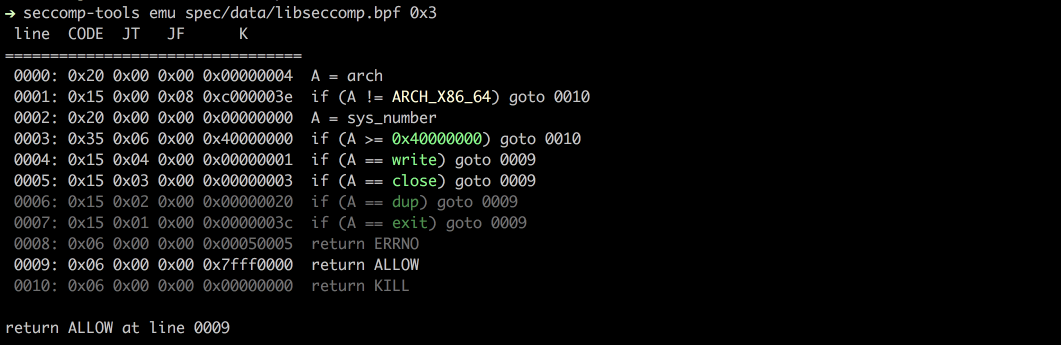
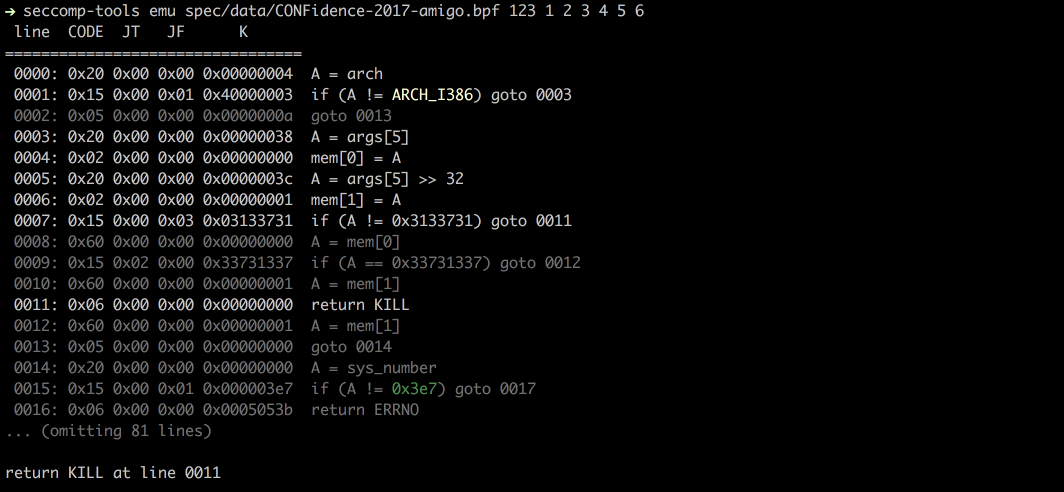
Emulates seccomp given sys_nr, arg0, arg1, etc.
$ seccomp-tools emu --help
# emu - Emulate seccomp rules.
#
# Usage: seccomp-tools emu [options] BPF_FILE [sys_nr [arg0 [arg1 ... arg5]]]
#     -a, --arch ARCH                  Specify architecture.
#                                      Supported architectures are <aarch64|amd64|i386|riscv64|s390x>.
#                                      Default: auto-detected from the host machine.
#                                      Set it when the filter targets an architecture other than the host.
#     -q, --[no-]quiet                 Run quietly, only show emulation result.
#     -i, --ip=VAL                     Set instruction pointer.

$ seccomp-tools emu spec/data/libseccomp.bpf write 0x3
#  line  CODE  JT   JF      K
# =================================
#  0000: 0x20 0x00 0x00 0x00000004  A = arch
#  0001: 0x15 0x00 0x08 0xc000003e  if (A != ARCH_X86_64) goto 0010
#  0002: 0x20 0x00 0x00 0x00000000  A = sys_number
#  0003: 0x35 0x06 0x00 0x40000000  if (A >= 0x40000000) goto 0010
#  0004: 0x15 0x04 0x00 0x00000001  if (A == write) goto 0009
#  0005: 0x15 0x03 0x00 0x00000003  if (A == close) goto 0009
#  0006: 0x15 0x02 0x00 0x00000020  if (A == dup) goto 0009
#  0007: 0x15 0x01 0x00 0x0000003c  if (A == exit) goto 0009
#  0008: 0x06 0x00 0x00 0x00050005  return ERRNO(5)
#  0009: 0x06 0x00 0x00 0x7fff0000  return ALLOW
#  0010: 0x06 0x00 0x00 0x00000000  return KILL
#
# return ALLOW at line 0009
Explain
Summarizes a whole filter as a per-action policy: which syscalls end in ALLOW, KILL, ERRNO, etc.,
and under what argument constraints. The input can be a dumped BPF file, an executable (its seccomp is
dumped first, like dump), or a running process via --pid.
$ seccomp-tools explain --help
# explain - Summarize a seccomp filter as a per-action policy.
#
# Usage: seccomp-tools explain [options] [BPF_FILE|EXEC]
#     -c, --sh-exec <command>          Executes the given command (via sh) and explains its seccomp.
#                                      Use this to pass arguments or pipe things to the executable.
#                                      e.g. use `-c "./bin > /dev/null"` to keep the program output out of the result.
#                                      Takes precedence over the positional argument.
#     -l, --limit LIMIT                Explain only the first LIMIT installed filters.
#                                      Only meaningful when the input is an executable or --pid. Default: 1
#                                      An executable is killed once it reaches LIMIT.
#     -p, --pid PID                    Explain the seccomp filters installed on an existing process.
#                                      You must have CAP_SYS_ADMIN (e.g. be root) to use this option.
#     -t, --timeout SEC                Timeout (seconds) for the execution. Default: no timeout
#                                      This option is ignored when --pid is given.
#     -a, --arch ARCH                  Specify architecture.
#                                      Supported architectures are <aarch64|amd64|i386|riscv64|s390x>.
#                                      Default: auto-detected from the host machine.
#                                      Set it when the filter targets an architecture other than the host.
#                                      With an executable or --pid the architecture is auto-detected instead.

$ seccomp-tools explain spec/data/libseccomp.bpf -a amd64
# Seccomp policy for spec/data/libseccomp.bpf
#
# Architecture: amd64
#
#   ALLOW:
#     write, close, dup, exit
#
#   ERRNO(5):
#     <default> (any other syscall)
#
#   KILL:
#     sys_number >= 0x40000000  (x32 ABI)
#
# Other architectures: KILL
A more involved example - the 0CTF/TCTF 2023 "Nothing is True" filter, which has separate 32/64-bit
allowlists and argument checks on open, mmap and execve:
$ seccomp-tools explain spec/data/tctf-2023-nothing-is-true.bpf -a amd64
# Seccomp policy for spec/data/tctf-2023-nothing-is-true.bpf
#
# Architecture: i386
#
#   ALLOW:
#     exit, read, write, brk, mmap, munmap, exit_group
#
#   KILL:
#     <default> (any other syscall)
#
# Architecture: amd64
#
#   ALLOW:
#     close, munmap, brk, exit, exit_group
#     open when filename == 0x31337 && flags == 0x0
#     mmap when prot == 0x2
#     execve when filename == 0x7ffea12f7d0e
#
#   KILL:
#     sys_number >= 0x40000000  (x32 ABI)
#     <default> (any other syscall)
#
# Other architectures: KILL
Audit
Scans a filter for weaknesses and likely escape routes - a missing architecture or x32 guard, a
permissive (denylist) default, equivalent-syscall gaps (e.g. execve blocked but execveat not),
an open/read/write chain, or dangerous syscalls reachable as ALLOW - and reports each with a
severity. It runs on every supported architecture (architecture-specific quirks like amd64's x32 are
applied only where they exist), and takes the same input as explain (a BPF file, an executable, or
--pid).
$ seccomp-tools audit --help
# audit - Assess a seccomp filter for weaknesses and escape routes.
#
# Usage: seccomp-tools audit [options] [BPF_FILE|EXEC]
#     -c, --sh-exec <command>          Executes the given command (via sh) and audits its seccomp.
#                                      Use this to pass arguments or pipe things to the executable.
#                                      e.g. use `-c "./bin > /dev/null"` to keep the program output out of the result.
#                                      Takes precedence over the positional argument.
#     -l, --limit LIMIT                Audit only the first LIMIT installed filters.
#                                      Only meaningful when the input is an executable or --pid. Default: 1
#                                      An executable is killed once it reaches LIMIT.
#     -p, --pid PID                    Audit the seccomp filters installed on an existing process.
#                                      You must have CAP_SYS_ADMIN (e.g. be root) to use this option.
#     -t, --timeout SEC                Timeout (seconds) for the execution. Default: no timeout
#                                      This option is ignored when --pid is given.
#     -a, --arch ARCH                  Specify architecture.
#                                      Supported architectures are <aarch64|amd64|i386|riscv64|s390x>.
#                                      Default: auto-detected from the host machine.
#                                      Set it when the filter targets an architecture other than the host.
#                                      With an executable or --pid the architecture is auto-detected instead.
#     -f, --format FORMAT              Output format, one of <human|json>.
#                                      Default: human
Auditing a denylist with several escape routes (the TokyoWesterns CTF 2016 "diary" filter):
$ seccomp-tools audit spec/data/twctf-2016-diary.bpf -a amd64
# Seccomp audit of spec/data/twctf-2016-diary.bpf
# Architectures: amd64
#
# [HIGH] Architecture is never validated
#     The filter checks syscall numbers without ever comparing data[4] (arch). Numbers mean different syscalls under
#     another AUDIT_ARCH, so the checks can be dodged by invoking through a different ABI (e.g. i386 numbering on amd64).
#     fix:  Compare data[4] against your AUDIT_ARCH_* and KILL every architecture you do not explicitly handle.
#
# [HIGH] io_uring_setup is allowed (amd64)
#     io_uring_setup reaches ALLOW - reads/writes/opens as ring operations, bypassing filters on those syscalls.
#     fix:  Block io_uring_setup unless the program genuinely needs it.
#
# [HIGH] process_vm_readv is allowed (amd64)
#     process_vm_readv reaches ALLOW - read another process's memory.
#     fix:  Block process_vm_readv unless the program genuinely needs it.
#
# [HIGH] process_vm_writev is allowed (amd64)
#     process_vm_writev reaches ALLOW - write another process's memory.
#     fix:  Block process_vm_writev unless the program genuinely needs it.
#
# [HIGH] ptrace is allowed (amd64)
#     ptrace reaches ALLOW - inspect/inject into other processes.
#     fix:  Block ptrace unless the program genuinely needs it.
#
# [HIGH] A file can be opened and its contents copied out (amd64)
#     openat2, read and write all reach ALLOW, so the contents of an arbitrary file (e.g. the flag) can be copied straight
#     back out.
#     fix:  Deny the open-family syscalls unless the program genuinely needs arbitrary files.
#
# [HIGH] Default action is ALLOW (denylist) (amd64)
#     Any syscall the filter does not explicitly block is allowed; a denylist is bypassable by any syscall the author
#     overlooked.
#     fix:  Use an allowlist: default to KILL/ERRNO and permit only the needed syscalls.
#
# [HIGH] open/openat blocked but openat2 allowed (amd64)
#     open, openat denied, but the equivalent openat2 reaches ALLOW - same capability, different syscall number.
#     fix:  Deny every equivalent in the group: also block openat2.
#
# [HIGH] x32 ABI is not guarded (amd64)
#     Syscalls blocked by their native number are reachable via their x32 number (nr | 0x40000000): open, clone, fork,
#     vfork, execve, creat, openat, execveat.
#     fix:  After the arch check, KILL when sys_number >= 0x40000000 (or jset 0x40000000).
#
# [MEDIUM] connect is allowed (amd64)
#     connect reaches ALLOW - network access (exfiltration).
#     fix:  Block connect unless the program genuinely needs it.
#
# [MEDIUM] socket is allowed (amd64)
#     socket reaches ALLOW - network access (exfiltration).
#     fix:  Block socket unless the program genuinely needs it.
#
# [MEDIUM] fork/vfork/clone blocked but clone3 allowed (amd64)
#     fork, vfork, clone denied, but the equivalent clone3 reaches ALLOW - same capability, different syscall number.
#     fix:  Deny every equivalent in the group: also block clone3.
Use --format json for CI or tooling:
$ seccomp-tools audit spec/data/gctf-2019-quals-caas.bpf -a amd64 -f json
# {
#   "stacked_filters": 1,
#   "reports": [
#     {
#       "source": "spec/data/gctf-2019-quals-caas.bpf",
#       "arches": [
#         "amd64"
#       ],
#       "truncated": false,
#       "findings": [
#         {
#           "id": "dangerous-allow",
#           "severity": "medium",
#           "title": "connect is allowed",
#           "detail": "connect reaches ALLOW - network access (exfiltration).",
#           "arch": "amd64",
#           "syscalls": [
#             "connect"
#           ],
#           "condition": null,
#           "remediation": "Block connect unless the program genuinely needs it."
#         },
#         {
#           "id": "dangerous-allow",
#           "severity": "medium",
#           "title": "socket is allowed",
#           "detail": "socket reaches ALLOW - network access (exfiltration).",
#           "arch": "amd64",
#           "syscalls": [
#             "socket"
#           ],
#           "condition": "family == 0x2 && type == 0x1 && protocol == 0x0",
#           "remediation": "Block socket unless the program genuinely needs it."
#         }
#       ]
#     }
#   ]
# }
Shell Completion
seccomp-tools completion <bash|zsh|fish> prints a completion script for the given shell. Load it from your shell's startup file:
# bash (~/.bashrc)
eval "$(seccomp-tools completion bash)"

# zsh (~/.zshrc, after `compinit`)
eval "$(seccomp-tools completion zsh)"

# fish (~/.config/fish/config.fish)
seccomp-tools completion fish | source
To avoid the startup cost of evaluating it every time, write the script to the directory your shell loads completions from instead, e.g. seccomp-tools completion zsh > "${fpath[1]}/_seccomp-tools".
Screenshots
Dump
Emu
Supported Architectures
- x86_64
- x32
- x86
- arm64 (@saagarjha)
- s390x (@iii-i)
- riscv64
Pull requests adding support for more architectures are welcome!
Development
I recommend using rbenv to manage your Ruby environment.
Setup
- Install bundler
$ gem install bundler
- Clone the source
$ git clone https://github.com/david942j/seccomp-tools && cd seccomp-tools
- Install dependencies
$ bundle install
Run tests
$ bundle exec rake
I Need You
Any suggestions or feature requests are welcome! Feel free to file issues or send pull requests. And if you like this project, consider giving it a star 😬