
ZeroMQ messaging, built in Rust.
Connect threads, processes, hosts, and languages without a broker. Your application sends messages, OMQ handles the network. Queues all the way!
- libzmq compatibility. Familiar ZeroMQ socket patterns, compatible wire protocol, and a drop-in C API.
- High throughput, low latency. Millions of messages per second, low p99 latency, and scalable background IO. See the benchmarks.
- Compression. LZ4 and adaptive Zstd transports save bandwidth without changing application messages.
- One API across transports. inproc, IPC, TCP, UDP, WebSocket, QUIC, DART, and SHM. Sockets handle framing, reconnection, and back-pressure.
- Language support. Rust plus bindings for C/C++, Python, Ruby, Go, Java, Node.js, .NET, Lua, BEAM, Zig, and Crystal. OMQ.ts is a TypeScript browser client.
Usage
Same socket types, same connect/bind/send/recv:
cargo add omq-tokio --rename omq
cargo add tokio --features macros,rt-multi-thread
use omq::{Context, Message, Options, Result, SocketType};
#[tokio::main]
async fn main() -> Result<()> {
let ctx = Context::new();
let pull = ctx.socket(SocketType::Pull, Options::default());
let endpoint = pull.bind("tcp://127.0.0.1:0").await?;
let push = ctx.socket(SocketType::Push, Options::default());
push.connect(endpoint).await?;
push.send(Message::single("hello")).await?;
let msg = pull.recv().await?;
assert_eq!(&msg[0], b"hello");
Ok(())
}The application can await bind, connect, send, and recv on any runtime
like Tokio or Compio. OMQ handles the network on its own background IO threads.
Port 0 selects a free TCP port, returned by bind().
New to ZeroMQ? Start with GETTING_STARTED.md. More examples in examples/zguide/, a port of the ZeroMQ Guide patterns to OMQ.
Performance


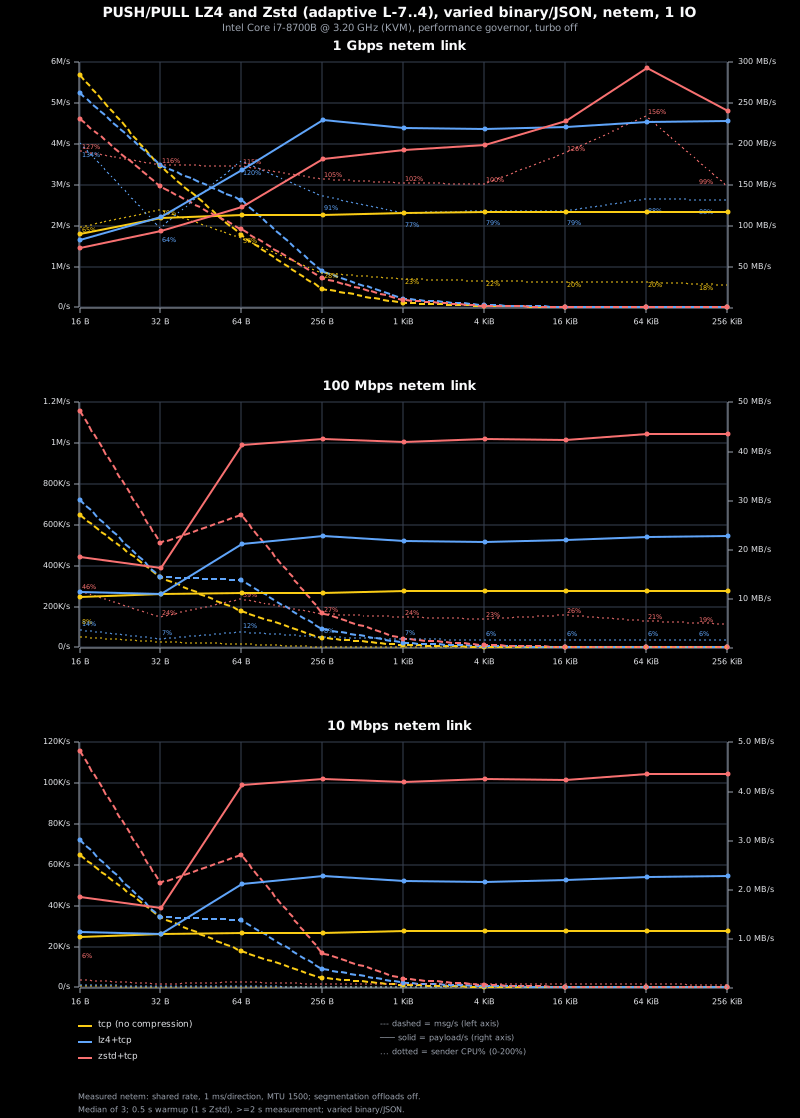
Full compression transport benchmarks (LZ4 and Zstd)
Full comparison charts | Other protocol comparisons
Behavior under load
- Abstraction. Connect-before-bind. Transparent reconnection. Peer failures never become send/recv errors.
- Back-pressure. HWM limits queues. Block or drop according to socket semantics.
- Fairness. Round-robin sends and fair-queued receives.
- Natural batching. Internal batches coalesce wakeups and writes. No explicit batches from application needed.
- Efficient payloads. Inline tiny messages, by-value inproc, gather writes for large payloads, opt-in buffer pools.
OMQ normally runs transport work on dedicated background IO threads, separate from application threads. Embedded and exclusive APIs are also available:
| API | IO placement |
|---|---|
Context::new().socket(...) |
OMQ-owned background IO threads, async API |
Context::new().blocking_socket(...) |
OMQ-owned background IO threads, synchronous API |
Context::current().socket(...) |
Existing tokio runtime |
omq_tokio::exclusive::Socket::{connect, bind}(...) |
Caller task, one TCP peer, no socket driver task |
Owned contexts support independent aggregate ingress/egress byte limits, configured before the first socket; exhaustion applies backpressure. Limits count transport bytes after compression and each fan-out copy; IPC, inproc, and SHM are excluded.
let ctx = omq::Context::new();
ctx.set_network_rate_limits(omq::NetworkRateLimits {
    ingress: None,
    egress: Some(omq::ByteRateLimit::new(10_000_000, 100_000)),
})?;
Cargo features
The default build includes the NULL mechanism and TCP / IPC / inproc / UDP, plus SHM on Linux. It needs no libzmq, libsodium, or C compiler. Optional features:
| Feature | Adds |
|---|---|
plain |
PLAIN username/password authentication (RFC 24) |
curve |
CURVE authentication and encryption (RFC 26) |
lz4 |
lz4+tcp:// compression (RFC) |
zstd |
Experimental zstd+tcp:// compression, with a level that adapts to the sender bottleneck |
ws |
WebSocket (ws://) and verified TLS (wss://) |
quic |
TLS-encrypted QUIC (quic://): overview, example
|
webtransport |
Browser WebTransport over HTTP/3 on quic:// listeners (RFC) |
dart |
Reliable ordered UDP (dart://) for low latency: overview, RFC
|
Workspace
Seven Cargo workspace crates. The protocol core, tokio backend, and WebTransport crates forbid unsafe Rust. SHM transport and native interfaces isolate unsafe operations.
| Crate | What it does |
|---|---|
omq-proto |
Sans-I/O ZMTP 3.x: codec, messages, mechanisms, subscriptions |
omq-tokio |
Tokio backend for Linux, macOS, and Windows |
omq-shm |
Linux shared-memory transport |
omq-libzmq |
libzmq-compatible C interface (libomq_zmq dynamic/static library) |
omq-bench |
Benchmark runner and SVG chart generator |
omq-webtrans-proto, omq-webtrans-quinn
|
WebTransport over HTTP/3, adapted from webtrans (MIT) |
Language bindings:
| Language | Binding |
|---|---|
| C/C++ |
omq-libzmq: libzmq-compatible C API |
| Python |
pyomq: synchronous and asyncio APIs |
| Ruby |
omq-rs: scheduler-aware synchronous API |
| Go |
OMQ.go: goroutine-safe API |
| Java |
OMQ.java: synchronous and async APIs |
| Node.js |
OMQ.node: native addon |
| .NET |
OMQ.Net: managed wrapper |
| Lua |
OMQ.lua: native module |
| Erlang, Elixir, Gleam |
OMQ.beam: NIF and wrappers |
| Zig |
OMQ.zig: C API wrapper |
| Crystal |
omq-binding.cr: native binding |
Pure implementations speak ZMTP without the Rust engine:
| Language | Implementation |
|---|---|
| TypeScript |
OMQ.ts: browser client over ws://, wss://, lz4+ws://, and WebTransport |
Sister projects
- OMQ.rb: Ruby implementation with compatible compression and an optional Rust backend.
Further reading
- COMPARISONS.md: cross-implementation comparison charts.
- PROTOCOL_COMPARISONS.md: throughput and request/reply-like latency against other messaging and RPC protocols.
- BENCHMARKS_COMPRESSION.md: LZ4 and Zstd transport throughput on bandwidth-limited links.
- doc/architecture.md: components, threads, and message paths.
- doc/bindings.md: C and language bindings.
- doc/libzmq/semantics.md: exact compatibility notes for no-peer sends, linger, and HWM.
- doc/lz4-rfc.md: LZ4 compression transport wire format and dictionary shipping rules.
- doc/quic-rfc.md: native QUIC transport, TLS verification, liveness, reconnect rules, and the WebTransport profile.
- doc/udp_transports.md: UDP, QUIC, and DART purposes, configuration, and benchmarks over loopback and lossy links.
- omq-shm/README.md: shared-memory transport on Linux.
Platform and requirements
- Rust 1.93 or newer (edition 2024).
- Linux (
x86_64,aarch64,i686-unknown-linux-gnu,armv7-unknown-linux-gnueabihf) - macOS (ARM/Intel)
- Windows
Linux is the primary development and benchmarking platform.
Contributing
See CONTRIBUTING.md for guidelines and DEVELOPMENT.md for build and test commands, and RUNNING_BENCHMARKS.md for benchmarks.
AI disclosure
This project was built with significant LLM assistance throughout: architecture, implementation, tests, benchmark infrastructure, and docs. It's an experiment in what LLM-assisted development can and can't do. The design decisions and direction are mine.
License
ISC.