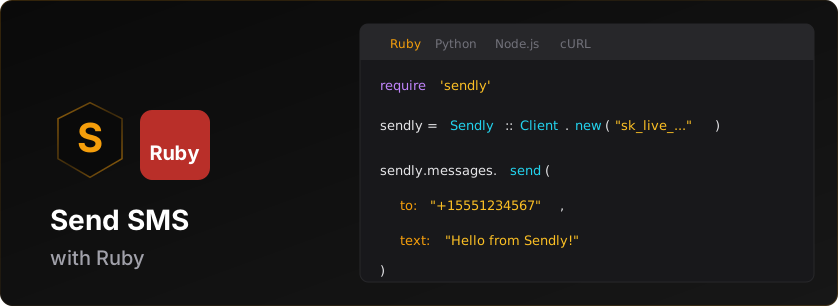
Sendly Ruby SDK
Official Ruby SDK for the Sendly SMS API.
Installation
# gem
gem install sendly

# Bundler (add to Gemfile)
gem 'sendly', '~> 4.2'

# then run
bundle install
Quick Start
require 'sendly'

# Create a client
client = Sendly::Client.new("sk_live_v1_your_api_key")

# Send an SMS
message = client.messages.send(
  to: "+15125550123",
  text: "Hello from Sendly!"
)

puts message.id     # => "msg_abc123"
puts message.status # => "queued"
Prerequisites for Live Messaging
Before sending live SMS messages, you need:
-
Business Verification - Complete verification in the Sendly dashboard
- International: Instant approval (just provide Sender ID)
- US/Canada: Requires carrier approval
-
Credits - Add credits to your account
- Test keys (
sk_test_*) work without credits (sandbox mode) - Live keys (
sk_live_*) require credits for each message
- Test keys (
-
Live API Key - Generate after verification + credits
- Dashboard → API Keys → Create Live Key
Test vs Live Keys
| Key Type | Prefix | Credits Required | Verification Required | Use Case |
|---|---|---|---|---|
| Test | sk_test_v1_* |
No | No | Development, testing |
| Live | sk_live_v1_* |
Yes | Yes | Production messaging |
Note: You can start development immediately with a test key. Messages to sandbox test numbers are free and don't require verification.
Configuration
Global Configuration
Sendly.configure do |config|
  config.api_key = "sk_live_v1_xxx"
end

# Use the default client
Sendly.send_message(to: "+15125550123", text: "Hello!")
Client Options
client = Sendly::Client.new(
  "sk_live_v1_xxx",
  base_url: "https://sendly.live/api/v1",
  timeout: 60,
  max_retries: 5,
  organization_id: "org_abc"   # sent as X-Organization-Id; defaults to ENV["SENDLY_ORG_ID"]
)

# The API key is also accepted as a keyword, for callers on the older signature.
client = Sendly::Client.new(api_key: "sk_live_v1_xxx")
The key is validated in the constructor: anything that is not
sk_test_v1_… or sk_live_v1_… raises Sendly::AuthenticationError
before a request is made. organization_id is also writable after
construction (client.organization_id = "org_abc").
Messages
Send an SMS
# Marketing message (default)
message = client.messages.send(
  to: "+15125550123",
  text: "Check out our new features!"
)

# Transactional message (bypasses quiet hours)
message = client.messages.send(
  to: "+15125550123",
  text: "Your verification code is: 123456",
  message_type: "transactional"
)

# With custom metadata (max 4KB)
message = client.messages.send(
  to: "+15125550123",
  text: "Your order #12345 has shipped!",
  metadata: { order_id: "12345", customer_id: "cust_abc" }
)

# Send from one of your owned numbers (or an alphanumeric sender ID).
# Omit `from` to use your default sender.
message = client.messages.send(
  to: "+15125550123",
  text: "Hello from our team!",
  from: "+447700900123"
)

puts message.id
puts message.status
puts message.credits_used
List Messages
# Basic listing
messages = client.messages.list(limit: 50)
messages.each { |m| puts m.to }

# With filters
messages = client.messages.list(
  status: "delivered",
  to: "+15125550123",
  limit: 20,
  offset: 0
)

# Pagination info: total counts every matching message, not just this page
puts messages.total
puts messages.has_more
A page holds at most 100 messages; a larger limit: is capped at 100.
Get a Message
message = client.messages.get("msg_abc123")

puts message.to
puts message.text
puts message.status
puts message.delivered_at
Scheduling Messages
# Schedule a message for future delivery
scheduled = client.messages.schedule(
  to: "+15125550123",
  text: "Your appointment is tomorrow!",
  scheduled_at: (Time.now.utc + 3600).iso8601  # 5 minutes to 5 days ahead
)

# schedule returns the raw Hash the API sent, not a Message object
puts scheduled["id"]
puts scheduled["scheduledAt"]

# List scheduled messages (returns a Hash with "data" array)
result = client.messages.list_scheduled
result["data"].each { |msg| puts "#{msg['id']}: #{msg['scheduledAt']}" }

# Get a specific scheduled message
msg = client.messages.get_scheduled("schd_xxx")

# Cancel a scheduled message (refunds credits)
result = client.messages.cancel_scheduled("schd_xxx")
puts "Refunded: #{result['creditsRefunded']} credits"
Batch Messages
# Send multiple messages in one API call (up to 10,000)
batch = client.messages.send_batch(
  messages: [
    { to: "+15125550123", text: "Hello User 1!" },
    { to: "+15125550124", text: "Hello User 2!" },
    { to: "+15125550125", text: "Hello User 3!" }
  ]
)

puts batch["batchId"]
puts "Status: #{batch['status']}"        # "processing" until the batch finishes
puts "Sent: #{batch['sent']}"
puts "Failed: #{batch['failed']}"
puts "Credits used: #{batch['creditsUsed']}"

# Get batch status. The stored batch — unlike the send response — also
# carries queued/delivered counts.
status = client.messages.get_batch("batch_xxx")
puts "#{status['queued']} queued, #{status['delivered']} delivered"

# List all batches
batches = client.messages.list_batches

# Preview batch (dry run) - validates without sending
preview = client.messages.preview_batch(
  messages: [
    { to: '+15125550123', text: 'Hello User 1!' },
    { to: '+447700900123', text: 'Hello UK!' }
  ]
)
puts "Credits needed: #{preview['creditsNeeded']} (balance #{preview['creditBalance']})"
puts "Sendable: #{preview['sendable']} of #{preview['total']}, blocked: #{preview['blocked']}"
puts "Enough credits? #{preview['hasSufficientCredits']}"
Iterate All Messages
each requests page after page until it has yielded every matching message,
so on a large account it makes many requests; break out of the block to stop
early. Without a block it returns an Enumerator.
# Auto-pagination
client.messages.each do |message|
  puts "#{message.id}: #{message.to}"
end

# With filters
client.messages.each(status: "delivered") do |message|
  puts "Delivered: #{message.id}"
end
Group MMS
Send one MMS to 2-8 US/Canada recipients who all share a single thread —
replies fan out to every participant. Group messaging is an A2P 10DLC
capability, so the sending number must be an MMS-enabled, 10DLC-registered
number you own. Omit from to use your workspace's default sender. Requires
the group_mms feature (and enable_mms when sending media).
group = client.messages.send_group(
  to: ["+14155550123", "+14155550124"],
  text: "Hey team - quick sync at noon?"
)

puts group.id                # => "msg_abc123"
puts group.group_message_id  # => "grp_..." (present on live sends)
puts group.status            # => "sent" (or "delivered" when simulated)
puts group.simulated?        # => true on test keys / before verification

# Recipients: on a live send each entry is a Hash with the per-recipient
# status ({ "phoneNumber" => "+14155550123", "status" => "queued" });
# on a simulated send each entry is the phone number String.
group.to.each { |r| puts r.is_a?(Hash) ? "#{r['phoneNumber']} #{r['status']}" : r }

# With media instead of (or in addition to) text
client.messages.send_group(
  to: ["+14155550123", "+14155550124"],
  media_urls: ["https://cdn.acme.example/flyer.jpg"],
  message_type: "marketing"
)
Billed per recipient. US/Canada destinations only. Without the group_mms
feature the API answers 403 feature_disabled (Sendly::APIError). A group
message the carrier refuses raises Sendly::ValidationError (422
send_failed), and its credits are refunded.
AI Message Enhancement
Rewrite a draft into a single, polished SMS segment (≤160 chars) and get a
short explanation of what changed. Pass message_type to steer the tone; with
no text the model generates a suitable message for that type. At least one of
text or message_type is required. Requires the ai_classification feature —
when AI is unavailable, the original text is returned with an empty explanation.
result = client.messages.enhance(
  text: "hey come check out our sale this weekend",
  message_type: "marketing"
)

puts result.enhanced     # polished, ≤160-char rewrite
puts result.explanation  # what changed and why
puts result.model        # model used (when available)
Idempotency
Every POST carries an automatically generated Idempotency-Key header. The
client keeps that key for every retry it makes on its own (a 5xx, or a 429 it
waits out; see Retries and rate limits), so a retry
of a request that already reached the API returns the original result instead
of sending and charging again. Pass your own key (1-255 printable ASCII
characters) when the guarantee needs to outlive the process, such as a job
queue that re-runs after a crash or your own retry loop; idempotency_key: is
accepted on messages.send, send_group, schedule, and send_batch.
message = client.messages.send(
  to: "+15125550123",
  text: "Your order has shipped!",
  idempotency_key: "order-4821-shipped"
)
The API records the answer under the key for a 2xx and for every 4xx except
429, and repeating the request with the same key within 24 hours returns that
recorded answer. A 5xx or a 429 is never recorded, so a retry under the same
key runs the request again. Reusing one of your own keys with a different body
is refused with 422 idempotency_key_mismatch (Sendly::ValidationError).
send_batch sends no automatic key, because the API already deduplicates
identical batches by their contents. This client raises Sendly::TimeoutError
and Sendly::NetworkError instead of retrying them, so those are exactly when
to retry with your own key.
Full details: https://sendly.live/docs/idempotency
Rate Limits
Requests are counted per API key in a fixed 60-second window that opens with the key's first request:
| Key | Requests per minute |
|---|---|
Test (sk_test_v1_*) |
60 |
Live (sk_live_v1_*) |
600 |
| Enterprise master key | 3000 |
Going over the limit returns a 429 rate_limit_exceeded with retryAfter in
the body. The client sleeps that long and retries, up to max_retries times
(default 3), then raises Sendly::RateLimitError, which carries retry_after
in seconds. Other 429s, and any wait over 60 seconds, are raised at once; see
Retries and rate limits for which ones.
Webhooks
Managing endpoints
# Create a webhook endpoint
webhook = client.webhooks.create(
  url: "https://acme.example/webhooks/sendly",
  events: ["message.delivered", "message.failed"]
)

puts webhook.id
puts webhook.secret  # Store securely!

# List all webhooks
webhooks = client.webhooks.list

# Get a specific webhook
wh = client.webhooks.get("whk_xxx")

# Update a webhook
client.webhooks.update("whk_xxx",
  url: "https://new-endpoint.acme.example/webhook",
  events: ["message.delivered", "message.failed", "message.sent"]
)

# Test a webhook. A delivered test returns a Sendly::WebhookTestResult; a
# test your endpoint fails raises Sendly::ValidationError with the API's
# message ("Test webhook failed: ...").
result = client.webhooks.test("whk_xxx")
puts "#{result.status_code} in #{result.response_time_ms}ms (#{result.delivery_id})"

# Rotate webhook secret. Deliveries are signed with the new secret from
# the moment it is issued and the old secret is not kept, so switch your
# endpoint over straight away. new_secret is shown only once.
rotation = client.webhooks.rotate_secret("whk_xxx")
puts rotation.new_secret
puts rotation.new_secret_version

# Delete a webhook
client.webhooks.delete("whk_xxx")

# Delivery history, newest first (limit defaults to 50, max 100), and a
# manual retry of one delivery
client.webhooks.deliveries("whk_xxx", status: "failed", limit: 20).each do |d|
  puts "#{d.event_type} #{d.status} (attempt #{d.attempt_number}/#{d.max_attempts})"
end
client.webhooks.retry_delivery("whk_xxx", "del_xxx")

# Event types the API describes (a subset: subscribe accepts every
# Sendly::Webhooks::EVENT_* constant except EVENT_MESSAGE_QUEUED)
client.webhooks.event_types.each { |t| puts t }
Webhook ids begin whk_ and delivery ids del_; both are checked in the
client, so a malformed id raises ArgumentError before a request goes out.
create likewise rejects a non-HTTPS URL and an empty event list. Signing
secrets begin whsec_.
After an outage the endpoint can be caught up, and a tripped circuit breaker reset. Both recovery calls are rejected with HTTP 409 while the circuit is still open, so reset first:
client.webhooks.reset_circuit("whk_xxx")

# Re-fire deliveries we recorded but could not deliver
client.webhooks.redeliver("whk_xxx",
  since: (Time.now.utc - 86_400).iso8601,
  event_types: ["message.delivered"],
  statuses: ["failed", "cancelled"],   # default
  limit: 1000)                         # default 1000, max 10000

# Synthesize events that never got an audit row at all (what redeliver
# cannot recover). A synthesized event reuses the id the original dispatch
# used, so dedupe on event.id. Not on event.data.object.id: a message's
# sent and delivered events share it.
client.webhooks.backfill("whk_xxx", since: (Time.now.utc - 86_400).iso8601)
Subscribe with the Sendly::Webhooks::EVENT_* constants rather than string
literals — a typo then fails at load time instead of in a 400. Every constant
but one names an event the API accepts on subscribe. The exception is
EVENT_MESSAGE_QUEUED: message.queued has never been emitted and is
rejected on subscribe with a 400 (Sendly::ValidationError). It is
deprecated, kept only so existing code still loads, and will be removed in the
next major. message.undelivered is rejected in the same way and has never had
a constant here. Subscribe to message.sent, message.failed and
message.bounced instead.
Receiving events
Sendly::Webhooks.parse_event verifies the signature and returns a
Sendly::WebhookEvent. Pass the raw request body — not a re-serialized hash,
which would no longer match the signature.
event = Sendly::Webhooks.parse_event(
  request.raw_post,
  request.headers["X-Sendly-Signature"],
  ENV.fetch("SENDLY_WEBHOOK_SECRET"),
  timestamp: request.headers["X-Sendly-Timestamp"]
)
Both are module functions on Sendly::Webhooks, not methods on
client.webhooks, and the argument order is payload, signature, secret,
with the timestamp as a keyword. Sendly::Webhooks.verify_signature is the
same check on its own, returning true/false instead of raising, for when
you want to verify without parsing. Passing the timestamp is recommended:
it is what binds the signature to a time, and a payload older than
Sendly::Webhooks::SIGNATURE_TOLERANCE_SECONDS (300) is then rejected.
event.raw_object is data.object exactly as it arrived, for every event
type. event.data is a hash-like view of the same object: read a key with
[] (String or Symbol), a reader method of the same name, or to_h.
case event.type
when Sendly::Webhooks::EVENT_MESSAGE_DELIVERED
  # message.* events also get a typed message view
  puts "#{event.message.id} -> #{event.message.to}"
when Sendly::Webhooks::EVENT_RCS_AGENT_LIVE
  puts event.data[:agent_id]
  puts event.data.stage
when Sendly::Webhooks::EVENT_CALL_COMPLETED
  puts event.data[:duration_secs]
end

# Or read data.object as a type of your own. A Struct or Data class is filled
# from the members it declares and ignores the rest of the payload, so a field
# added to the event later cannot break the call.
AgentLive = Struct.new(:agent_id, :name, :stage)
agent = event.object_as(AgentLive)
Two things the SDK will not do, because both make a handler act on data that was never sent:
-
Nothing is invented. A field the payload did not carry is
nil, andevent.data.key?(:segments)isfalse.segments,credits_used,direction,toandfromare no longer defaulted to1,0,"outbound"and"". -
nilstaysnil. An in-appcall.*event carriesfromandtoas JSONnull; they come back asnil, not"".
event.message is the message view and is nil for every event that is not a
message — rcs_*, whatsapp_*, call.*, short_code.*, brand.*,
campaign.*, assignment.*, number.*, port*, contact*,
conversation.* and draft.*, whose payloads are not message-shaped. verification.* events get
event.verification, a Sendly::WebhookVerificationData. event.data is the
typed view where one exists and a plain Sendly::WebhookObject otherwise, so
reading data.object works the same way for all of them, including an event
type this SDK predates.
Note that contact.auto_flagged carries the contact under id and the message
that failed under message_id; read the message with
event.data[:message_id].
Handling a lifecycle event
Only message.* events carry a message, and not message.opt_in or
message.opt_out: those carry an opt-out record (phone_number, keyword,
from_number), so their event.message is nil too. A lifecycle event — rcs_*,
whatsapp_*, call.*, short_code.*, brand.*, campaign.*,
assignment.*, number.*, port*, contact*, conversation.*,
draft.* — carries a different object,
so event.message is nil and you read data.object off event.data or
event.raw_object.
require "sendly"

# Framework-neutral: hand it the raw request body and a headers Hash.
def handle_sendly_webhook(raw_body, headers)
  event = Sendly::Webhooks.parse_event(
    raw_body,
    headers["X-Sendly-Signature"],
    ENV.fetch("SENDLY_WEBHOOK_SECRET"),
    timestamp: headers["X-Sendly-Timestamp"]
  )

  case event.type
  when Sendly::Webhooks::EVENT_RCS_AGENT_LIVE
    # data.object is the agent: agent_id, name, stage
    puts "RCS agent #{event.data[:name]} is #{event.data.stage}"
    puts event.data[:agent_id]
  when Sendly::Webhooks::EVENT_NUMBER_ACTIVATED
    # data.object is the number: id, phone, status, country_code, source
    puts "#{event.data[:phone]} active in #{event.data[:country_code]}"
  when Sendly::Webhooks::EVENT_CONTACT_AUTO_FLAGGED
    # the contact is `id`; the message that failed is `message_id`
    puts "flagged #{event.data[:id]} (#{event.data[:invalid_reason]})"
    puts "from message #{event.data[:message_id]}"
  when Sendly::Webhooks::EVENT_MESSAGE_DELIVERED
    # message.* events, and only these, also get the typed message view
    puts "#{event.message.id} delivered to #{event.message.to}"
  else
    # An event type this SDK predates still parses; raw_object holds all of it.
    puts "unhandled #{event.type}: #{event.raw_object.inspect}"
  end

  :ok
rescue Sendly::WebhookSignatureError
  :unauthorized
end
Reading a message field off a lifecycle event fails loudly rather than answering with a value the event never carried:
event.data.from
# => NoMethodError: undefined method 'from' for Sendly::WebhookObject:
#    this event's data.object carries agent_id, name, stage, organization_id
event.message      # => nil
event.message.id   # => NoMethodError — nil has no #id
Branch on event.type, or on event.message? / event.verification?, before
reaching for a typed view.
Account & Credits
# Get account information. name is the workspace's name; organization,
# credits, verification, api_key and limits are the API's Hashes as sent.
account = client.account.get
puts account.email
puts "#{account.name} (#{account.organization_id})"
puts account.verification&.dig("status")

# Check credit balance (a Sendly::Credits object, not a Hash)
credits = client.account.credits
puts "Available: #{credits.available_balance} credits"
puts "Reserved: #{credits.reserved_balance} credits"
puts "Total: #{credits.balance} credits"

# View credit transaction history
transactions = client.account.transactions
transactions.each do |tx|
  puts "#{tx.type}: #{tx.amount} credits - #{tx.description}"
end

# List API keys
keys = client.account.api_keys
keys.each do |key|
  puts "#{key.name}: #{key.prefix} (#{key.type})"
end

# Create a new API key. type: is "test" (the default) or "live"; scopes:
# defaults to every scope the calling key has and cannot go beyond them.
# A live key needs a verified business and credits: the API answers 403
# verification_required or 402 credits_required otherwise.
result = client.account.create_api_key('Production Key', type: 'live', scopes: ['sms:send', 'sms:read'])
puts "New key: #{result['key']}"  # Only shown once!

# Rotate an API key. Issues a new key and keeps the old one valid for a grace
# period (default 24h; 24-168 allowed) so you can deploy before the old expires.
rotation = client.account.rotate_api_key('key_xxx', grace_period_hours: 72)
puts "New key: #{rotation['newKey']['key']}"  # Only shown once!
puts rotation['message']                      # "Old key will expire in 72 hours"

# Revoke an API key (an optional reason is recorded on the key's audit trail)
client.account.revoke_api_key('key_xxx', reason: 'rotated out of CI')

# Fetch one key, and its usage statistics
key = client.account.api_key('key_xxx')
puts "#{key.name}: #{key.scopes.join(', ')}#{key.revoked? ? ' (revoked)' : ''}"
usage = client.account.api_key_usage('key_xxx')

# Move credits to another workspace you own
client.account.transfer_credits(target_organization_id: 'org_xyz', amount: 500)
Contacts
Manage your contact directory. list returns a Hash with a :contacts array
of Contact objects plus pagination fields.
# Create a contact
contact = client.contacts.create(
  phone_number: "+15125550123",
  name: "Alice Example",
  email: "alice@acme.example",
  metadata: { plan: "pro" }
)

# List / search (scope to a list with list_id:)
result = client.contacts.list(limit: 50, search: "alice")
result[:contacts].each { |c| puts "#{c.name}: #{c.phone_number}" }
puts result[:total]

# Get, update, delete
c = client.contacts.get(contact.id)
client.contacts.update(contact.id, name: "Alice E.")  # see the note below
client.contacts.delete(contact.id)

# A contact's helper flags
puts c.opted_out?  # excluded from marketing sends
puts c.invalid?    # auto-flagged as unreachable (landline / bad number)

# Bulk import (dedupes by phone; each entry is a Hash)
report = client.contacts.import_contacts(
  [
    { phone: "+15125550123", name: "Alice" },
    { phone: "+15125550124", name: "Bob", email: "bob@acme.example" }
  ],
  list_id: "list_abc"
)
puts "Imported #{report[:imported]}, skipped #{report[:skipped_duplicates]}, errors #{report[:total_errors]}"

# Clear the auto-invalid flag (single or bulk). bulk_mark_valid takes
# either ids: (up to 10,000) or list_id: — not both.
client.contacts.mark_valid("contact_1")
client.contacts.bulk_mark_valid(list_id: "list_abc")
report = client.contacts.bulk_mark_valid(ids: ["contact_1", "contact_2"])
puts "Cleared #{report[:cleared]}"

# Trigger a carrier line-type lookup (async; landlines get excluded)
client.contacts.check_numbers(list_id: "list_abc", force: false)
update returns a Contact built from the API's update response, which
leaves out opted_out and created_at: on that object opted_out? is
false and created_at is nil whatever the contact holds. Read those with
contacts.get.
Contact Lists
Group contacts into lists for campaigns. Access via client.contacts.lists.
# Create and manage lists
list = client.contacts.lists.create(name: "VIP Customers", description: "Top spenders")
all = client.contacts.lists.list
all[:lists].each { |l| puts "#{l.name} (#{l.contact_count})" }

# Get a list (paginate its members)
detail = client.contacts.lists.get(list.id, limit: 100, offset: 0)

client.contacts.lists.update(list.id, name: "VIPs")

# Add / remove members
result = client.contacts.lists.add_contacts(list.id, ["contact_1", "contact_2"])
puts "Added #{result[:added_count]}"
client.contacts.lists.remove_contact(list.id, "contact_1")

client.contacts.lists.delete(list.id)
Campaigns
Send one message to every contact on a contact list. A campaign targets a
single list: contact_list_ids: takes an Array, but the API refuses more than
one ID with a 400.
# Create a campaign
campaign = client.campaigns.create(
  name: "Spring Sale",
  text: "Our spring sale is live! 20% off everything.",
  contact_list_ids: ["list_abc"]
)

# Preview cost + reachability before sending
preview = client.campaigns.preview(campaign.id)
puts "Recipients: #{preview.recipient_count}"
puts "Credits needed: #{preview.estimated_credits}"
puts "Enough credits? #{preview.enough_credits?}"

# Send now. The result is a Sendly::CampaignSendResult (a Sendly::Campaign)
# describing the batch the messages went out in: status is the batch's
# ("processing", "completed", "partial_failure" or "failed").
result = client.campaigns.send_campaign(campaign.id)
puts "Batch #{result.batch_id}: #{result.sent_count}/#{result.recipient_count} sent, " \
     "#{result.failed_count} failed, #{result.credits_used} credits"

# The campaign itself is "completed" once sent
puts client.campaigns.get(campaign.id).completed?

# Or, instead of sending now, schedule a draft for later
client.campaigns.schedule(campaign.id, scheduled_at: (Time.now.utc + 86_400).iso8601, timezone: "America/New_York")

# List, update, cancel, clone, delete
client.campaigns.list(status: "completed")[:campaigns].each { |c| puts "#{c.name}: #{c.status}" }
client.campaigns.update(campaign.id, name: "Spring Sale (v2)")
client.campaigns.cancel(campaign.id)
client.campaigns.clone(campaign.id)
client.campaigns.delete(campaign.id)
Templates
Reusable message templates with variables. AI can also draft one for you.
# Create / list / get. New templates start as drafts; publish to lock one for use.
template = client.templates.create(
  name: "Order shipped",
  text: "Hi {{name}}, order {{order_id}} has shipped!"
)
client.templates.list[:templates].each { |t| puts "#{t.name} — #{t.status}" }
t = client.templates.get(template.id)

# Update (drafts only) and publish
client.templates.update(template.id, text: "Hi {{name}}, your order is on the way!")
client.templates.publish(template.id)

# Copy a template into a new draft, then delete the original
copy = client.templates.clone(template.id, name: "Order shipped (v2)")
client.templates.delete(template.id)

# Generate a template with AI
generated = client.templates.generate(description: "A friendly appointment reminder")
puts generated.text
puts generated.variables.inspect
Conversations
Two-way messaging threads with your contacts.
# List conversations (Enumerable)
conversations = client.conversations.list(status: "active")
conversations.each { |c| puts "#{c.phone_number}: #{c.last_message_text}" }

# Get one, optionally with its messages
convo = client.conversations.get("conv_abc", include_messages: true)

# Reply in a thread with text, media, or both (a reply with neither raises
# Sendly::ValidationError before anything is sent). Returns a Sendly::Message.
client.conversations.reply("conv_abc", text: "Thanks for reaching out!")
client.conversations.reply("conv_abc", media_urls: ["https://cdn.acme.example/menu.jpg"])

# Lifecycle + metadata
client.conversations.mark_read("conv_abc")
client.conversations.close("conv_abc")
client.conversations.reopen("conv_abc")
client.conversations.update("conv_abc", tags: ["priority"], metadata: { csat: 5 })

# Apply / remove labels
client.conversations.add_labels("conv_abc", label_ids: ["label_1"])
client.conversations.remove_label("conv_abc", label_id: "label_1")

# AI: conversation context + suggested replies
context = client.conversations.get_context("conv_abc", max_messages: 20)
puts context.token_estimate

replies = client.conversations.suggest_replies("conv_abc")
replies.each { |r| puts "[#{r.tone}] #{r.text}" }

# Auto-paginate every conversation
client.conversations.each(status: "active") { |c| puts c.id }
Drafts
Stage replies for review before they're sent (approve → sends via the API).
draft = client.drafts.create(
  conversation_id: "conv_abc",
  text: "Here's the info you asked for.",
  source: "agent"
)

client.drafts.list(conversation_id: "conv_abc", status: "pending").each { |d| puts d.text }
client.drafts.update(draft.id, text: "Here is the info you asked for.")

# Approve (sends the message) or reject with a reason
client.drafts.approve(draft.id)
client.drafts.reject(draft.id, reason: "Needs the discount code")
Labels
Organize conversations with labels.
label = client.labels.create(name: "Urgent", color: "#ff0000", description: "Needs a fast reply")
client.labels.list.each { |l| puts l.name }
client.labels.delete(label.id)
Rules
Automations that act on inbound messages based on conditions.
rule = client.rules.create(
  name: "Auto-label opt-outs",
  conditions: { intent: "opt_out" },
  actions: { addLabels: ["label_1"] },
  priority: 1
)

client.rules.list.each { |r| puts "#{r.name} (priority #{r.priority})" }
client.rules.update(rule.id, priority: 2)
client.rules.delete(rule.id)
Verify
Phone verification (OTP) — send a code, then check it. Hosted verification
sessions are available under client.verify.sessions.
# Send a verification code
verification = client.verify.send(to: "+15125550123", app_name: "Acme")
puts verification.id

# Check the code the user entered
result = client.verify.check(verification.id, code: "123456")
puts result.verified?

# Resend, fetch, and list
client.verify.resend(verification.id)
client.verify.get(verification.id)
client.verify.list[:verifications].select { |v| v.status == "verified" }.each { |v| puts v.phone }

# Hosted verification session (returns a URL to send the user to)
session = client.verify.sessions.create(
  success_url: "https://acme.example/verified",
  brand_name: "Acme"
)
puts session.url
check = client.verify.sessions.validate(token: "session_token")
puts check.valid?
Media
Upload an image to attach to an MMS (returns a hosted media URL).
# From a file path
media = client.media.upload("flyer.jpg", content_type: "image/jpeg")
puts media.url

# ...then attach it to a send
client.messages.send(to: "+15125550123", text: "Check this out!", media_urls: [media.url])
Numbers
Search for, list, and purchase phone numbers. Requires an API key with the
numbers:read / numbers:write scopes.
# List supported countries and the number types available in each
client.numbers.list_countries[:countries].each do |country|
  puts "#{country.code} #{country.name}: #{country.number_types.join(', ')}"
end

# Find available numbers (monthly_cost is already customer-priced)
result = client.numbers.list_available(country: 'GB', type: 'mobile', contains: '777')
number = result[:numbers].first
puts "#{number.phone_number} — #{number.monthly_cost} #{number.currency}/mo"

# List numbers you already own
client.numbers.list[:numbers].each do |n|
  puts "#{n.phone_number} (#{n.status})"
end

# Buy a number
purchase = client.numbers.buy(
  phone_number: number.phone_number,
  country_code: number.country,
  phone_number_type: number.number_type,
  monthly_cost: number.monthly_cost
)

case purchase.status
when 'provisioning'
  puts "Provisioning #{purchase.number.phone_number}"
when 'documents_required', 'payment_required'
  # The action carries TWO different identifiers, and they are not
  # interchangeable:
  #   action_code       - the short code you SHOW the user to type on the
  #                       hosted page. Display only.
  #   action_identifier - the 32-hex identifier you PASS BACK to buy.
  puts "Visit #{purchase.action_url} and enter code #{purchase.action_code}"
  # ...after the action completes, re-call buy with the same arguments plus:
  # client.numbers.buy(..., action_code: purchase.action_identifier)
end

# Get one number you own (includes is_default, which the list omits)
number = client.numbers.get('num_abc123')
puts "#{number.phone_number} — default sender: #{number.is_default}"
puts "voice: #{number.voice_enabled?} (#{number.voice_mode})"

# Update a number — make it the default sender (must be active),
# and/or cancel a scheduled release ("keep this number")
client.numbers.update('num_abc123', is_default: true)
client.numbers.update('num_abc123', pending_cancellation: false)

# Release a number. A live paid purchase is cancelled at the end of the paid
# period (scheduled?), everything else is released immediately.
result = client.numbers.release('num_abc123')
if result.scheduled?
  puts "Releases at #{result.scheduled_release_at}"
else
  puts "Released"
end
10DLC (Local Number Texting)
Register your business for carrier review so you can text from local
(10-digit) US numbers. Requires an API key with the tendlc:read /
tendlc:write scopes; writes need a live key.
# 1. Register a brand for carrier review
brand = client.ten_dlc.create_brand(
  legal_name: 'Acme Holdings LLC',
  ein: '12-3456789',
  website: 'https://acme.example',
  email: 'ops@acme.example'
)

# Poll until the brand is verified (or failed, with failure_reasons)
refreshed = client.ten_dlc.get_brand(brand.id)
puts refreshed.status  # "pending" -> "verified"

# 2. Pre-check your use case, then create a campaign
check = client.ten_dlc.qualify(brand.id, 'MIXED')
if check.qualified?
  campaign = client.ten_dlc.create_campaign(
    brand_id: brand.id,
    use_case: 'MIXED',
    description: 'Order updates and support replies for Acme customers',
    message_flow: 'Customers opt in at checkout on acme.example',
    sample_messages: ['Your order #123 has shipped!'],
    opt_out_keywords: 'STOP'
  )

  # Poll until carriers approve
  approved = client.ten_dlc.get_campaign(campaign.id)
  puts approved.status            # "awaiting_review" -> "pending" -> "active"
  puts approved.throughput&.tier  # e.g. "Standard"

  # 3. Assign a number you own — it can send once the assignment is Active
  assignment = client.ten_dlc.assign_number(campaign.id, phone_number: '+15125550123')
  puts assignment.status  # "Under review" -> "Active"
end

# List everything
client.ten_dlc.list_brands[:brands].each { |b| puts "#{b.legal_name} — #{b.status}" }
client.ten_dlc.list_campaigns[:campaigns].each { |c| puts "#{c.use_case} — #{c.status}" }
client.ten_dlc.list_assignments[:assignments].each { |a| puts "#{a.phone_number} — #{a.status}" }
Short Codes
This SDK has no short-code resource. There is no client.short_codes;
short-code applications are handled in the dashboard, or over REST. What
the SDK does carry is the four lifecycle events, as constants you can
subscribe to and branch on:
client.webhooks.create(
  url: "https://acme.example/webhooks/sendly",
  events: [
    Sendly::Webhooks::EVENT_SHORT_CODE_ACTION_REQUIRED, # something needs you
    Sendly::Webhooks::EVENT_SHORT_CODE_REJECTED,        # data.object[:reason]
    Sendly::Webhooks::EVENT_SHORT_CODE_FILED,           # filed with the carriers
    Sendly::Webhooks::EVENT_SHORT_CODE_LIVE             # data.object[:short_code]
  ]
)

case event.type
when Sendly::Webhooks::EVENT_SHORT_CODE_LIVE
  # data.object carries short_code_id, short_code and organization_id
  puts "#{event.data[:short_code]} is live"
when Sendly::Webhooks::EVENT_SHORT_CODE_ACTION_REQUIRED
  puts "waiting on you at stage #{event.data[:stage]}"
end
These are lifecycle events, so event.message is nil and you read
data.object through event.data or event.raw_object, as with every
other non-message event.
To drive an application from code meanwhile, call the REST endpoints
directly with an API key holding the short_codes:read /
short_codes:write scopes:
| Method | Path | Scope |
|---|---|---|
GET |
/api/v1/short_codes |
short_codes:read |
POST |
/api/v1/short_codes/requests |
short_codes:write |
GET |
/api/v1/short_codes/application |
short_codes:read |
PUT |
/api/v1/short_codes/application |
short_codes:write |
POST |
/api/v1/short_codes/application/preflight |
short_codes:read |
POST |
/api/v1/short_codes/application/submit |
short_codes:write |
The client's own HTTP
methods reach them without a dedicated resource — paths are relative to the
/api/v1 base:
application = client.get("/short_codes/application")The write endpoints take the application form's fields as their body. This
SDK does not model them, so check the API reference for the shape rather
than guessing: client.put and client.post pass a Hash through as JSON
unchanged (client.delete takes no body), and every client.post carries an
Idempotency-Key as usual.
Business Entity Upgrade
client.business_upgrade runs the toll-free entity upgrade: when you form
a new legal entity, reserve a new toll-free number under it, submit it for
carrier review, and swap over on approval. The current number keeps sending
throughout the 1-2 week review.
# Validate before submitting — advisory only, nothing is written.
# verdict is "ready", "warnings" or "blocked".
preview = client.business_upgrade.preflight(
  business_name: "Acme Holdings LLC",
  brn: "12-3456789",
  brn_type: "EIN",                    # Sendly::BusinessUpgradeResource::BRN_TYPES
  brn_country: "US",
  entity_type: "PRIVATE_PROFIT"       # Sendly::BusinessUpgradeResource::ENTITY_TYPES
)
puts preview["verdict"]
preview["issues"].each { |i| puts "#{i['severity']} #{i['field']}: #{i['code']}" }

# Prefill from the caller's other verified workspaces
best = client.business_upgrade.best_prefill

# Submit, with the IRS letter attached (ein_doc_path OR ein_doc, not both)
client.business_upgrade.start("ws_abc",
  business_name: "Acme Holdings LLC",
  brn: "12-3456789",
  brn_type: "EIN",
  brn_country: "US",
  entity_type: "PRIVATE_PROFIT",
  ein_doc_path: "./CP-575.pdf")

client.business_upgrade.status("ws_abc")     # { "pending" => nil } when none
client.business_upgrade.resubmit("ws_abc", contact_email: "ops@acme.example")
client.business_upgrade.cancel("ws_abc")

# After approval, decide what happens to the old toll-free number
client.business_upgrade.set_disposition("ws_abc",
  disposition: "moved",                      # or "released"
  target_workspace_id: "ws_other")
URL Shortening (Branded Links)
Mint branded short links for a destination URL, list them with click analytics, and disable an individual link (a per-link kill switch). Branded, owned-domain short links improve deliverability — carriers filter public shorteners — and give you click data.
Not yet GA. URL shortening is gated behind the
url_shortenerrollout flag (currently founder-only). Until the flag is on for your account, calls return a 404 (Sendly::NotFoundError) — the feature reads as absent.
# Shorten a URL (must be http/https)
link = client.links.create(url: "https://acme.example/spring-sale?utm_source=sms")
puts link.short_url        # => "https://sendly.live/l/Ab3xY7"
puts link.code             # => "Ab3xY7"
puts link.destination_url  # => "https://acme.example/spring-sale?utm_source=sms"

# List your links with click counts (limit 1-200, default 50)
listing = client.links.list(limit: 20)
puts listing.total
listing.each do |l|
  puts "#{l.short_url} -> #{l.destination_url} (#{l.click_count} clicks)"
  puts "  last click: #{l.last_country} #{l.last_clicked_at}"
  puts "  14-day spark: #{l.spark.inspect}"
end

# Disable (redirect returns 404) or re-enable a link
client.links.disable(link.code)
client.links.enable(link.code)

# Or set the state explicitly
status = client.links.update(link.code, disabled: true)
puts status.disabled?Connect a number you own to WhatsApp, create Meta-reviewed message
templates, and send via client.messages.send(channel: "whatsapp", ...).
Connecting is a one-time $19 setup (no monthly fee). The first number always
ends with a human step: the signup returns a connect URL a person must open in
a browser and log in with Facebook to link their WhatsApp Business Account.
More numbers can then be added to that account with a 6-digit code Meta sends
to the number, with no Facebook step (same $19 fee, refunded if it fails).
Sends go through messages.send(channel: "whatsapp") and need sms:send,
not whatsapp:write. Reads (signup.get, templates, the window, senders and
sender profiles) need whatsapp:read and accept test keys. Signup, template
create/edit/delete and profile edits need whatsapp:write and a live key
(otherwise 403 whatsapp_requires_live_key). Sends need a live key too. In a
team workspace, connecting and profile edits need an owner or admin
(settings:write), and template writes need an owner, admin or member
(templates:write). A missing role returns 403 insufficient_permissions.
Reading conversational components needs whatsapp:read too and accepts test
keys. The profile photo, conversational component and calling changes, and
submitting or resending a verification code, need the same as a profile edit.
WhatsApp is enabled per person: the user who owns the API key, not the
workspace. While it is off, sends return 403 whatsapp_not_enabled and the
/api/v1/whatsapp/* management routes return 404 not_found.
Free-form text and media only deliver inside a 24-hour customer-service
window (opened by the recipient messaging you); an approved template works
anytime. Templates are reviewed by Meta (typically 24-48h) and categorized
as authentication, utility, or marketing; category is required on create,
with no default, and an update can't change it.
Pricing: free-form text or media inside the 24-hour window costs 1 credit each for the first 1,000 per sending number per calendar month (UTC), then the destination's utility template price; countries without a listed price use the default utility price of 12 credits. Templates are priced by category and destination country; countries without a listed price use 33 (marketing), 12 (utility) and 12 (authentication) credits. A failed send gives its slot back. Note: Meta has paused marketing template delivery to US (+1) numbers.
# 1. Connect a number ($19 one-time; a human must open the connect URL)
signup = client.whatsapp.signup.create(phone_number: "+15125550123")
puts "Have your user open: #{signup.connect_url}"

# 2. Poll until active. After the Facebook step the signup is "registering"
# while WhatsApp activates the number. Activation usually takes a few minutes
# but can take hours. If it hasn't finished about 6 hours after the session
# began, the session fails with registration_timeout and the fee is refunded.
# If the connection fails, the $19 fee is refunded automatically; once a
# number has connected, a later disconnect gets nothing back.
status = client.whatsapp.signup.get(signup.id)
puts status.failure_reasons if status.failed?  # e.g. ["waba_mismatch"]

# List your connected senders
client.whatsapp.senders.list[:senders].each do |s|
  puts "#{s.phone_number} (#{s.display_name || 'no name yet'}) — #{s.status}"
end

# Read and update a sender's business profile (what recipients see when
# they open your details in WhatsApp)
profile = client.whatsapp.senders.get_profile("+15125550123")
puts profile.display_name
puts profile.about

client.whatsapp.senders.update_profile(
  "+15125550123",
  about: "Fresh roasted coffee, delivered.",               # max 139 chars
  description: "Small-batch roaster shipping nationwide.", # max 512 chars
  website: "https://acme.example"
)

# Profile photo: a JPEG or PNG of at most 5 MB, square, at least 192 px wide
client.whatsapp.senders.upload_profile_photo("+15125550123", "logo.png",
                                             content_type: "image/png", filename: "logo.png")
client.whatsapp.senders.delete_profile_photo("+15125550123")

# Ice breakers (tappable suggestions on a first chat) and "/" commands. Each
# list you pass replaces the stored one; [] clears it.
client.whatsapp.senders.update_conversational_components(
  "+15125550123",
  ice_breakers: ["Track my order", "Opening hours"],     # at most 4
  commands: [{ command: "menu", description: "See today's menu" }]  # at most 30
)
components = client.whatsapp.senders.get_conversational_components("+15125550123")
components.commands.each { |c| puts "/#{c.command}: #{c.description}" }

# WhatsApp calling: WhatsApp users calling the number ring like a phone call.
# Switch voice on for the number first. There is no API for placing WhatsApp
# calls.
settings = client.whatsapp.senders.set_calling("+15125550123", enabled: true)
puts settings.calling_enabled?

# Add another number to the account you already connected: no Facebook step.
# Meta sends the number a 6-digit code by text ("sms", the default) or call.
sender = client.whatsapp.senders.list[:senders].find(&:active?)
added = client.whatsapp.signup.create(
  phone_number: "+15125550124",
  business_account_id: sender.business_account_id,
  verification_method: "sms"
)
puts added.status  # "verifying"

# The code can be read back once Meta's text arrives on the number. Until a
# code has been submitted it is the newest code since the signup started, so
# after a resend it still shows the earlier code until the new one arrives.
# Once WhatsApp has checked a code, only a code that arrived after the last
# submission or resend is returned. A 502 whatsapp_verification_unavailable
# isn't counted, so the same unchecked code can come back, and submitting it
# again is safe.
code = client.whatsapp.signup.get(added.id).verification_code
client.whatsapp.signup.verify(added.id, code: code) if code
# Or ask for a new one (at most every 30 seconds)
client.whatsapp.signup.resend(added.id, verification_method: "voice")

# 3. Create a template (Meta reviews it, usually 24-48h)
template = client.whatsapp.templates.create(
  sender: "+15125550123",
  name: "order_shipped",
  language: "en_US",
  category: "UTILITY",
  header: "Order update",  # fixed text only: a header with {{n}} is refused
  body: "Hi {{1}}, your order {{2}} has shipped!",
  examples: { "1" => "Sam", "2" => "#4821" }
)
puts template.status  # "PENDING"

# List, edit-and-resubmit (the recovery path for rejections), or delete
client.whatsapp.templates.list[:templates].each { |t| puts "#{t.name} — #{t.status}" }
client.whatsapp.templates.update(template.id, body: "Hi {{1}}, order {{2}} is on its way!",
                                              examples: { "1" => "Sam", "2" => "#4821" })
client.whatsapp.templates.delete(template.id)

# 4. Send — free-form inside an open 24h window, template anytime. The window
# is exactly { open, expiresAt }: no window on record reads open false with
# expires_at nil; an expired one reads open false with its past expires_at.
window = client.whatsapp.window(from: "+15125550123", to: "+15555550100")
if window.open?
  client.messages.send(
    channel: "whatsapp",
    to: "+15555550100",
    from: "+15125550123",
    text: "Your table is ready!"
  )
else
  message = client.messages.send(
    channel: "whatsapp",
    to: "+15555550100",
    from: "+15125550123",
    template: {
      name: "order_shipped",
      language: "en_US",
      variables: { "1" => "Acme Inc", "2" => "#4821" }
    }
  )
  puts message.whatsapp.kind  # "template"
end

# Media with a caption (also window-bound; one attachment per message)
client.messages.send(
  channel: "whatsapp",
  to: "+15555550100",
  from: "+15125550123",
  text: "Here is your receipt",
  media_urls: ["https://acme.example/receipt.pdf"]
)
WhatsApp errors map onto the usual classes:
-
signup.createraisesSendly::ServerErrorfor 503whatsapp_unavailablewhile WhatsApp connections are unavailable. Only signup returns it; no send does. Nothing is charged, the response carries aRetry-After: 3600header, ande.response_body["retryAfter"](3600) says how many seconds to wait; the client retries it like any 5xx before raising. After 5 failed, charged signups in 24 hours it raisesSendly::RateLimitErrorfor 429whatsapp_signup_limit_reached, which is not retried: try again the next day. - A send outside an open window raises
Sendly::ValidationError(422whatsapp_window_closed); send a template instead. -
whatsapp_send_failedis aSendly::ValidationError(422) when WhatsApp refused the message, which is final (cached under the idempotency key and replayed for 24 hours), and aSendly::ServerError(502) when the message provably never reached the carrier, so it was not sent and is safe to send again; the 502 is never cached and the client retries it first under the same idempotency key. Neither is charged. -
whatsapp_send_unconfirmedis aSendly::APIErrorwithstatus_code409: the outcome is unknown. The message was marked failed and refunded but may still be delivered, so check before sending it again (it could arrive twice). It is not retried automatically, and it is cached under the idempotency key. - A send while WhatsApp is off for the key's owner gets 403
whatsapp_not_enabled; a test key on a send or a write gets 403whatsapp_requires_live_key. -
templates.createfor a sender that isn't connected raisesSendly::NotFoundError(404whatsapp_sender_not_connected), checked before anything else. - A template the API refuses for its content raises
Sendly::ValidationError(400) with atemplate_*code ine.response_body["error"]:template_category_invalid(category missing or not one of the three),template_authentication_otp_button_required,template_authentication_no_links(a link in the body or a URL button on an authentication template) ortemplate_header_variable_unsupported. A marketing template without an opt-out button only gets a warning.template_already_exists,template_name_lockedandtemplate_not_editableare aSendly::APIErrorwithstatus_code409, andtemplate_not_foundis aSendly::NotFoundError. - Adding a number by code:
signup.createwithbusiness_account_id:raisesSendly::NotFoundErrorfor 404whatsapp_business_account_not_found(the account isn't connected in this workspace),Sendly::ValidationErrorfor 400display_name_requiredand for 422whatsapp_verification_start_failed(WhatsApp refused to verify the number; final),Sendly::APIError(409) forwhatsapp_signup_in_progressandwhatsapp_already_enabled, andSendly::ServerErrorfor 502whatsapp_verification_start_failed(WhatsApp couldn't start verifying the number; start again). Either failure fails the session and refunds its fee. Withbusiness_account_id:the client never retries a 5xx, a timeout or a dropped connection, because each retry would start a new charged session. A Facebook signup for a number that is being added by code gets 409whatsapp_verification_in_progress, with that session's id ine.response_body["id"]. -
signup.verifyraisesSendly::ValidationErrorfor 400invalid_verification_code(not 6 digits) and 422whatsapp_verification_code_invalid(a wrong code, withe.response_body["attemptsRemaining"]);Sendly::APIError(409) forwhatsapp_verification_failed(after 5 wrong codes the session fails and the fee is refunded),whatsapp_verification_busy(try again) andsignup_not_active; andSendly::ServerErrorfor 502whatsapp_verification_unavailable(the attempt isn't counted) andwhatsapp_activation_pending(the code was accepted but connecting didn't finish; check back shortly withsignup.get). The client never retries a 5xx, a timeout or a dropped connection fromsignup.verify: each submission uses one of the 5 attempts.signup.resendis retried like any other call. -
signup.resendraisesSendly::RateLimitErrorfor 429whatsapp_verification_resend_too_soonat once, with the seconds to wait ine.retry_after, andwhatsapp_verification_resend_failedas aSendly::ValidationError(422) or aSendly::ServerError(502). -
senders.upload_profile_photoraisesSendly::ValidationErrorfor 400whatsapp_profile_photo_invalid(not a JPEG or PNG) andfile_required, andSendly::APIErrorwithstatus_code413 forwhatsapp_profile_photo_too_large. The photo methods raiseSendly::ServerErrorfor 502whatsapp_profile_update_failed, and the conversational component methods for 502whatsapp_conversational_components_fetch_failedandwhatsapp_conversational_components_update_failed; an invalid list is aSendly::ValidationError(400invalid_request) with a message naming the problem. The client never retries a 5xx, a timeout or a dropped connection fromsenders.upload_profile_photo. -
senders.set_callingraisesSendly::APIError(409) forvoice_not_enabled(switch voice on for the number first),Sendly::ValidationErrorfor 422whatsapp_calling_unavailable(Meta only allows calling once the account may message at least 2,000 people a day and the display name is approved), andSendly::ServerErrorfor 502whatsapp_calling_update_failed. - A sender method for a number that isn't connected raises
Sendly::NotFoundError(404whatsapp_sender_not_connected).
RCS
Send branded rich messages — text with suggested replies and actions, or
rich cards with an image and buttons — through your workspace's RCS agent
by passing channel: "rcs" to client.messages.send. Delivery is
per-recipient: not every device or network supports RCS. Text sends fall
back to plain SMS automatically (billed as SMS) unless you disable the
fallback; rich cards have no SMS form and only deliver to RCS-capable
recipients.
The RCS channel is being rolled out gradually and is not yet generally
available; until it is enabled for your account the endpoints read as
absent and calls raise Sendly::NotFoundError (HTTP 404: not_found on
sends and listing, rcs_not_enabled on registration). RCS sends and
capability checks require a live API key.
Registering an agent
Registration is self-serve, from the dashboard or the API. Draft the
brand (the business) and the agent (what recipients see), submit them for
Sendly's review, and once approved they go on to the carrier network for
brand verification and agent review. The agent then reaches invited test
devices only; when you have tested it, request launch and Sendly reviews
the campaign before sending the launch on to the carrier network. Watch
customer_stage (one of Sendly::RcsRegistration::CUSTOMER_STAGES) to
see where a registration is.
Registration reads need the rcs:read scope and writes rcs:write; test
and live keys both work, since drafting is not carrier-backed. Logo, hero
and call-to-action media must be public https:// URLs: assets cannot be
uploaded over the API, only from the dashboard. Nested hashes (address,
contact, basics, campaign, testing) accept snake_case or camelCase keys.
Every write accepts idempotency_key:; POSTs get an auto-generated key
as usual, while PATCH and PUT send one only when you pass it.
# Where is the registration at?
reg = client.rcs.registration.get
puts reg.stage  # "draft" until something is submitted

# Seed the brand from details Sendly already holds (your 10DLC brand or
# toll-free verification), then fill in the rest
dossier = client.rcs.dossier.get
brand = client.rcs.brands.create(**dossier.brand)  # dossier.source: "tendlc", "verification" or "none"
client.rcs.brands.update(brand.id,
  display_name: "Acme Coffee",
  legal_entity_type: "LIMITED_LIABILITY_COMPANY",
  contact: { first_name: "Sam", last_name: "Lee", email: "sam@acme.example",
             phone_number: "+15125550123" }
)

# Draft the agent. Media must be public https URLs.
agent = client.rcs.agents.create(
  brand_id: brand.id,
  display_name: "Acme Coffee",
  use_case: "MULTI_USE",
  basics: {
    description: "Order updates and offers from Acme Coffee",
    logo_url: "https://acme.example/rcs/logo.png",
    hero_url: "https://acme.example/rcs/hero.png",
    brand_color: "#5B3A29",
    privacy_policy_url: "https://acme.example/privacy",
    terms_and_conditions_url: "https://acme.example/terms",
    phone_number: { number: "+15125550123", label: "Support" }
  }
)

# Submit for Sendly's review. Pass your own key if you may retry: a replay
# returns the original response without submitting again.
agent = client.rcs.agents.submit(agent.id, idempotency_key: "rcs-submit-#{agent.id}")
puts agent.review_status  # "awaiting_review"

# Later: poll, and act on a review note
agent = client.rcs.agents.get(agent.id)
if agent.changes_requested?
  puts agent.review_note
  client.rcs.agents.update(agent.id, basics: { hero_url: "https://acme.example/rcs/hero-v2.png" })
end

# Once the agent is in testing, invite devices, describe the campaign,
# then request launch
client.rcs.agents.set_test_devices(agent.id, devices: [
  { phone_number: "+15125550123", label: "Sam's Pixel" }
])
client.rcs.agents.update(agent.id,
  campaign: {
    company_overview: "Specialty coffee roaster with three cafes in Austin",
    agent_overview: "Order updates, pickup alerts and support replies",
    interactions: [{ interaction_type: "TRANSACTIONAL_UPDATES",
                     description: "Order and pickup status" }],
    message_examples: ["Your order #4821 has shipped!",
                       "Your latte is ready for pickup at 5th St",
                       "Reply HELP for support or STOP to opt out"],
    consent_settings: {
      opt_in_methods: [{ method_type: "WEBSITE", description: "Checkbox at checkout" }],
      call_to_action: "Get order updates by RCS",
      call_to_action_url: "https://acme.example/updates",
      double_opt_in: false,
      help_response: "Acme Coffee: reply STOP to opt out, or email help@acme.example",
      opt_out_response: "You're opted out of Acme Coffee updates."
    }
  }
)
client.rcs.agents.request_launch(agent.id, test_url: "https://acme.example/rcs-test")
Registration errors map onto the usual classes: Sendly::NotFoundError
for rcs_not_enabled and rcs_not_found; Sendly::ValidationError for
rcs_us_only and rcs_invalid_content, whose field_errors is the API's
list of { "path", "message" } hashes; and Sendly::APIError with
status_code 409 for rcs_field_locked, rcs_brand_not_verified and
rcs_launch_not_ready, or 403 for a key missing the scope.
Sending
# Discover your RCS agents ("testing" reaches invited test devices only;
# "approved" reaches everyone). Pass agent_id on sends and capability
# checks when your workspace has more than one agent.
client.rcs.agents.list[:agents].each do |a|
  puts "#{a.name} — #{a.status}#{a.sendable? ? ' (sendable)' : ''}"
end

# Pre-flight: can this recipient receive RCS?
capability = client.rcs.capability(to: "+15125550123")
puts capability.capable? ? "RCS" : "would fall back to SMS"

# Text with suggested replies and actions. Nested suggestion and card
# hashes are passed through verbatim, so they use the camelCase keys the
# API expects.
message = client.messages.send(
  channel: "rcs",
  to: "+15125550123",
  text: "Your order has shipped! Want live updates?",
  suggestions: [
    { reply: { text: "Yes, notify me", postbackData: "notify_yes" } },
    { action: { text: "Track order", postbackData: "track",
                url: "https://acme.example/orders/4821" } }
  ]
)

# The response discloses which channel delivered
puts message.channel # "rcs", or "sms" when it fell back
if message.fell_back?
  # Delivered as plain SMS (billed as SMS). Suggestions have no SMS form
  # and were dropped — message.rcs.suggestions_dropped is true.
else
  puts message.rcs.kind       # "text" or "card"
  puts message.rcs.agent_name # the brand name recipients see
end

# Rich card (RCS-capable recipients only — cards have no SMS form)
client.messages.send(
  channel: "rcs",
  to: "+15125550123",
  card: {
    title: "Spring collection",
    description: "New arrivals are in - take a look.",
    mediaUrl: "https://acme.example/spring.jpg", # public JPEG, PNG, or GIF
    orientation: "vertical",                    # or "horizontal"
    suggestions: [
      { action: { text: "Shop now", postbackData: "shop",
                  url: "https://acme.example/spring" } }
    ]
  }
)

# Opt out of the SMS fallback — the send raises Sendly::ValidationError
# (HTTP 422 rcs_not_supported_for_recipient) when the recipient can't
# receive RCS
client.messages.send(
  channel: "rcs",
  to: "+15125550123",
  text: "RCS or nothing",
  fallback_to_sms: false
)
Voice Calls
Place phone calls that one of your AI agents handles, list and inspect
calls, end a call early, and download recordings. Agents are created with
client.voice.agents or in the dashboard under Calls, then Agents; the
number you call from must have voice switched on and an emergency address
registered before it can place outbound calls (see
Configure voice, or Calls, then Settings in the
dashboard). Each Sendly::PhoneNumber
from client.numbers.list carries voice_enabled? and voice_mode
("none", "ring_dashboard" or "agent") so you can pick a from:
from = client.numbers.list[:numbers].find(&:voice_enabled?)&.phone_numberCalls are prepaid from your credit balance per started minute: 2 credits a
minute outbound, plus 8 a minute while an AI agent is on the call (10 in
total for an API-placed call). Unanswered calls cost nothing. Destinations
are US and Canadian numbers. Reads need the calls:read scope; create
and hangup need calls:write and a live key.
Rolling out. Voice is enabled workspace by workspace. Until it is on for yours, every
client.callsandclient.voicemethod raisesSendly::NotFoundError(voice_not_enabled).
# Place a call. Returns at once with the call ringing; the agent greets the
# callee when they answer and uses `context` for this call only.
call = client.calls.create(
  to: "+15125550123",
  agent_id: "3c4d5e6f-7081-4293-a4b5-c6d7e8f90a1b",
  from: "+15555550100",                # optional when you have one voice number
  context: "Confirm the 3pm appointment on Tuesday.",
  metadata: { "crmId" => "lead_8812" } # up to 20 string pairs, echoed everywhere
)
puts call.id
puts call.status        # "ringing"
puts call.handled_by    # "agent"

# Follow it. Agent-handled calls include a transcript once fetched by id.
call = client.calls.get(call.id)
puts call.status        # "ringing" -> "active" -> "completed" (or no_answer, busy, ...)
puts call.hangup_class  # why it ended, e.g. "agent_agent_hangup"
puts call.credits_charged
call.transcript&.each { |line| puts "#{line.speaker}: #{line.text}" }

# List (newest first; limit 1-100, default 50)
page = client.calls.list(status: "completed", direction: "outbound", agent_id: call.agent_id, limit: 20)
page.each { |c| puts "#{c.to} #{c.duration_secs}s #{c.credits_charged} credits" }
puts page.total
puts page.has_more?

# End a call. Ringing -> "cancelled", active -> "completed"; a call that
# has already ended comes back unchanged.
client.calls.hangup(call.id)

# Recording. The URL is signed and valid for five minutes; it is nil until
# the recording is ready. Ogg/Opus; agent calls are dual channel, with the
# agent on the left channel and the other party on the right.
rec = client.calls.recording(call.id)
if rec.ready?
  File.binwrite("#{call.id}.ogg", Net::HTTP.get(URI(rec.url)))
end
Call errors map onto the usual classes: Sendly::InsufficientCreditsError
when the balance cannot cover one minute at the agent rate;
Sendly::NotFoundError for voice_not_enabled, outbound_calls_not_enabled,
agent_not_found, number_not_found and call_not_found;
Sendly::ValidationError for invalid_number, destination_not_supported,
agent_required, invalid_metadata, from_number_required and
from_number_not_supported (a from that is not a US or Canadian number);
Sendly::RateLimitError for daily_call_limit; Sendly::APIError with
status_code 428 for e911_required (register an emergency address for the
number), 409 for agent_disabled, no_voice_number and lines_busy (retry
shortly), or 403 for live_key_required and a key missing the scope; and
Sendly::ServerError (a sibling of APIError, not a subclass) for 503
voice_unavailable / agents_unavailable and 500 voice_internal_error.
The full list is Sendly::Call::ERROR_CODES; the hangup vocabulary is
Sendly::Call::HANGUP_CLASSES.
call.channel is where the call took place: "phone", "whatsapp" (a
WhatsApp call, for example one placed from the dashboard) or "browser"
(Sendly::Call::CHANNELS); a value this SDK predates comes through unchanged.
An inbound WhatsApp call can read "phone" until the carrier labels it.
call.started, call.completed and call.recording.ready webhooks carry
the same object in snake_case (channel, handled_by, hangup_class,
billing, metadata, ...); read it from event.data, for example
event.data[:channel].
Configure voice
Everything a call depends on is configurable from code with client.voice:
switch voice on for a number and choose how it answers, register the
number's emergency address, and create the AI agents that talk. Reads need
the calls:read scope; writes need calls:write and a live key. In a team
workspace, changing a number or its emergency address also needs a role that
can change settings, and managing agents a role that can manage API keys
(each agent holds its own scoped sending key).
# Numbers. Pass the number's id or its E.164 phone number.
client.voice.numbers.list.each do |n|
  puts "#{n.phone_number} #{n.voice_mode} #{n.emergency_address&.status || 'no emergency address'}"
end
number = client.voice.numbers.get("+15125550123")
puts number.rate_per_minute.agent   # credits a minute when an agent answers

# A US or Canadian number needs an emergency address before it can place
# calls. The first registration adds $1.50 a month to the number;
# registering again replaces the address without a second charge.
number = client.voice.numbers.register_emergency_address(
  "+15125550123",
  street: "500 Example Ave",
  unit: "Suite 2",
  city: "Austin",
  state: "TX",
  zip: "78701"                      # country: defaults to "US"
)
puts number.emergency_address.status

# Voices and agents. An agent answers real callers on any number pointed at it.
client.voice.voices.list.each { |v| puts "#{v.id}: #{v.label}" }

agent = client.voice.agents.create(
  name: "Front desk",
  voice: "ashley",
  greeting: "Thanks for calling Acme, how can I help?",
  instructions: "Answer questions about opening hours and take a message for anything else.",
  tools: { send_sms: true }         # snake_case or camelCase keys
)
puts agent.can_send_sms?            # true once it holds its scoped sending key
client.voice.agents.update(agent.id, greeting: "Thanks for calling Acme. How can I help today?")
client.voice.agents.list.each { |a| puts "#{a.name}: #{a.calls_handled} calls" }

# Switching voice on changes how real calls to the number are answered.
client.voice.numbers.update("+15125550123", voice_enabled: true, voice_mode: "agent", agent_id: agent.id)
client.voice.numbers.update("+15125550123", voice_mode: "ring_dashboard") # ring the team instead
client.voice.numbers.update("+15125550123", voice_enabled: false)         # switch voice off

# An agent that answers a number can't be deleted until the number is moved.
begin
  client.voice.agents.delete(agent.id)
rescue Sendly::APIError => e
  raise unless e.response_body&.dig("error") == "agent_in_use"

  puts "Still answers #{e.response_body['numbers'].join(', ')}"
end
A mode alone is enough: voice_mode: "agent" or "ring_dashboard" switches
voice on, so it can fail the way switching on does, and voice_mode: "none"
switches it off. voice_enabled: false wins over any mode, and
voice_enabled: true with "none" answers in "ring_dashboard" mode.
Configuration errors map the same way: Sendly::NotFoundError for
number_not_found and agent_not_found; Sendly::ValidationError for
invalid_request (for example an emergency address field that is not a
string), invalid_voice_mode, agent_required,
e911_not_applicable and invalid_address (a 422 invalid_address means
the address could not be validated, and e.response_body["suggested"] holds
a corrected address when one was found); Sendly::APIError with
status_code 409 for agent_disabled, agent_limit (20 agents per
workspace) and agent_in_use; and Sendly::ServerError for 502
voice_attach_failed and carrier_refused and 503 voice_unavailable,
raised after the client has already retried the 5xx on its own. Not every
carrier_refused is worth retrying: when the message says the number
couldn't be found for emergency registration, retrying won't help, so
contact support. When it says the address couldn't be registered or
emergency calling couldn't be switched on, try again later. Every API error
keeps the parsed body on e.response_body.
Error Handling
begin
  message = client.messages.send(
    to: "+15125550123",
    text: "Hello!"
  )
rescue Sendly::AuthenticationError => e
  puts "Invalid API key"
rescue Sendly::RateLimitError => e
  if e.response_body&.dig("error") == "too_many_failed_key_attempts"
    # Repeated wrong API keys from this address locked it out for up to
    # 5 minutes. Fix the key; do not retry until the lockout ends.
    puts "Locked out for #{e.retry_after}s: check the API key"
  else
    puts "Rate limited (#{e.response_body&.dig('error')}), retry after #{e.retry_after} seconds"
  end
rescue Sendly::InsufficientCreditsError => e
  puts "Add more credits to your account"
rescue Sendly::ValidationError => e
  puts "Invalid request: #{e.message}"
rescue Sendly::NotFoundError => e
  puts "Resource not found"
rescue Sendly::NetworkError => e
  puts "Network error: #{e.message}"
rescue Sendly::Error => e
  puts "Error: #{e.message} (#{e.response_body&.dig('error') || e.code})"
end
Every error is a Sendly::Error, which carries message, code,
status_code, details and response_body — the parsed JSON body of the
API's response, or nil for an error raised before the request went out.
The API's own error code is e.response_body["error"]; code is the SDK's
name for the class ("VALIDATION_ERROR", "RATE_LIMIT_EXCEEDED" and so on),
except on APIError, where it is the body's "code" when there is one. Some
refusals put more in that body than a message: a 409 agent_in_use lists the
numbers under "numbers", a 422 invalid_address carries a corrected
address under "suggested".
Some requests are refused before they are sent, with response_body nil:
an argument the method checks itself raises ArgumentError or
Sendly::ValidationError, and any ID that is empty, "." or ".." raises
Sendly::ValidationError, so an ID can never send a request to a different
endpoint.
| Class | Raised for |
|---|---|
Sendly::AuthenticationError |
401, and a missing or malformed API key at construction |
Sendly::ValidationError |
400 and 422; field_errors holds the API's errors list. status_code reads 400 for both, so tell them apart by response_body["error"]
|
Sendly::InsufficientCreditsError |
402 |
Sendly::NotFoundError |
404, including a feature that is not enabled for you |
Sendly::RateLimitError |
429; retry_after in seconds when the API sent one |
Sendly::ServerError |
5xx |
Sendly::APIError |
any other non-2xx status |
Sendly::NetworkError |
connection refused or reset, DNS failure |
Sendly::TimeoutError |
a timeout (subclass of NetworkError) |
Sendly::WebhookSignatureError |
a webhook signature that does not verify, or a malformed payload |
ServerError and APIError are siblings — both inherit Sendly::Error
directly — so rescuing APIError does not catch a 5xx.
Retries and rate limits
The client retries two kinds of response by itself, up to max_retries
(default 3), and sends every retry with the same idempotency key, generated
or yours:
- any 5xx, with exponential backoff (2, 4, 8... seconds);
- a 429 that waiting can fix, when its wait is 60 seconds or less: an
ordinary
rate_limit_exceeded, the per-minuteprovision_rate_limitfrom enterprise workspace provisioning (120 provisioning requests a minute), a 429 with noerrorcode, ortoo_many_concurrent_verifications(too many first-time API key checks at once). The wait is read from theRetry-Afterheader first, then from the body'sretryAfter, so a 429 from a proxy that sends only the header is waited out too.
Every other 429 is raised at once as a Sendly::RateLimitError, with the
API's code in e.response_body["error"] and the wait in e.retry_after:
-
too_many_failed_key_attempts: repeated wrong API keys from one address locked it out for up to 5 minutes. Fix the key, then wait, since until the lockout ends the right key can be refused too. -
rate_limit_exceededfromverify.sendandverify.resendat the per-phone limit (5 codes per 10 minutes) or the daily limit (20 a day), while more than a minute of that window remains, so the call raises instead of blocking and then sending a code nobody is waiting for. In the window's last minute the wait is 60 seconds or less, and the client waits it out and sends the code like any other rate limit. - the hourly
provision_rate_limit(1,000 provisioning requests an hour; aprovision_bulkcall counts as one), so you can pace provisioning. It too is waited out once 60 seconds or less of the hour remain. -
whatsapp_signup_limit_reachedanddaily_call_limit.
A 429 with no wait at all is raised at once too. Timeouts and network errors
are never retried: retry those yourself, with your own idempotency key.
enterprise.upload_verification_document, business_upgrade.start and
business_upgrade.resubmit send their uploads once, so any 429 or 5xx there
is raised at once.
Message Object
message.id           # Unique identifier
message.to           # Recipient phone number
message.from         # Sender ID or number (the default sender when you omit from:; "SENDLY-TEST" when simulated)
message.text         # Message content
message.status       # see Message Status below
message.direction    # "outbound" or "inbound"
message.segments     # Number of SMS segments
message.credits_used # Credits consumed
message.is_sandbox   # true for a simulated message (read it via messages.get or list; a send response leaves it false)
message.sender_type  # "number_pool", "alphanumeric" or "explicit" (live sends only)
message.created_at   # Creation time (Time)
message.delivered_at # Delivery time (Time, if delivered)
message.error        # Error message (if failed)
message.error_code   # Error code (if failed)
message.retry_count  # Delivery retry attempts
message.metadata     # The metadata Hash you attached
message.media_urls   # Attachments of an MMS; [] when there are none
message.message_format # "sms", "mms", "rcs" or "whatsapp" ("sms" when the API does not say)
message.ai_metadata  # AI classification, on inbound messages
message.warning      # Warning about the send, when the API sent one
message.sender_note  # Note about sender behaviour, when the API sent one

# Helper methods
message.delivered?   # => true/false
message.failed?      # => true/false
message.pending?     # => true/false
message.to_h         # => Hash of the above
There is no updated_at and no error_message; the failure text is on
error. Sendly::Message is what messages.send, messages.get and
messages.list return for SMS — a WhatsApp send returns a
Sendly::WhatsAppMessage, an RCS send a Sendly::RcsMessage, and a group
send a Sendly::GroupMessage, each with its own channel fields.
Message Status
Sendly::Message::STATUSES is the vocabulary:
| Status | Description |
|---|---|
queued |
Message is queued for delivery |
sent |
Message was sent to carrier |
delivered |
Message was delivered |
failed |
Message delivery failed |
bounced |
Invalid recipient, or the carrier rejected it |
retrying |
A failed send is being retried |
There is no sending status. WhatsApp and RCS additionally report reads,
as the message.read webhook (Sendly::Webhooks::EVENT_MESSAGE_READ);
SMS has no read receipts.
Pricing Tiers
Per segment, at 1 credit = $0.01.
| Tier | Countries | Credits per SMS |
|---|---|---|
| Domestic | US, CA | 2 |
| Tier 1 | GB, AU, PL, PT, SE, DK, etc. | 8 |
| Tier 2 | FR, JP, IN, IT, etc. | 12 |
| Tier 3 | DE, MX, etc. | 16 |
| Tier 4 | GE, MU, ME, AD, etc. | 24 |
| Tier 5 | IL, SI, etc. | 48 |
A multi-segment message costs its tier's rate per segment. Enterprise accounts can have per-country or per-tier rates overridden, in which case the override applies instead.
Sandbox Testing
Use test API keys (sk_test_v1_xxx) with these test numbers:
| Number | Behavior |
|---|---|
| +15005550000 | Success (instant) |
| +15005550001 | Fails: invalid_number |
| +15005550002 | Fails: unroutable_destination |
| +15005550003 | Fails: queue_full |
| +15005550004 | Fails: rate_limit_exceeded |
| +15005550006 | Fails: carrier_violation |
Enterprise
The Enterprise API lets you programmatically manage workspaces, verification, credits, and API keys for multi-tenant platforms. It requires an enterprise master key — an ordinary live key (sk_live_v1_…) that has been marked as your organization's master key in the dashboard; what distinguishes it is the flag on the key, not the prefix. A non-master key is refused with 403 enterprise_required, and a master key whose enterprise account is inactive with 403 enterprise_inactive. Master keys also get the higher rate limit of 3,000 requests a minute.
Quick Provision
Create a fully configured workspace in a single call:
client = Sendly::Client.new(api_key: "sk_live_v1_your_master_key")

result = client.enterprise.provision(
  name: "Acme Insurance - Austin",
  source_workspace_id: "ws_verified",
  credit_amount: 5000,
  credit_source_workspace_id: "SOURCE_WORKSPACE_ID",
  key_name: "Production",
  key_type: "live",
  generate_opt_in_page: true
)

puts result["workspace"]["id"]
puts result["key"]["key"]
Three provisioning modes:
| Mode | Params | Description |
|---|---|---|
| Inherit | source_workspace_id: |
Shares toll-free number from verified workspace |
| Inherit + New Number |
source_workspace_id: + inherit_with_new_number: true
|
Copies business info, purchases new number |
| Fresh | verification: { ... } |
Full business details, new number + carrier approval |
Workspace Management
ws = client.enterprise.workspaces.create(name: "Acme Insurance")
list = client.enterprise.workspaces.list
detail = client.enterprise.workspaces.get("ws_xxx")
client.enterprise.workspaces.delete("ws_xxx")
Credits & API Keys
client.enterprise.workspaces.transfer_credits("ws_dest",
  source_workspace_id: "ws_source", amount: 5000)

# type: is "test" (the default) or "live"; scopes: defaults to every scope.
# A name is required: a missing or empty one raises ArgumentError.
key = client.enterprise.workspaces.create_key("ws_xxx",
  name: "Production", type: "live", scopes: ["sms:send", "sms:read"])
puts key["key"]      # shown only once
puts key["scopes"].inspect

client.enterprise.workspaces.revoke_key("ws_xxx", "key_abc")
Webhooks & Analytics
client.enterprise.webhooks.set(url: "https://hooks.acme.example/enterprise")
client.enterprise.webhooks.test
client.enterprise.webhooks.rotate_secret

overview = client.enterprise.analytics.overview
messages = client.enterprise.analytics.messages(period: "30d")
delivery = client.enterprise.analytics.delivery
credits  = client.enterprise.analytics.credits(period: "30d")
The rest of the enterprise surface
# Verification, per workspace. A first submission needs business_name, website,
# address, contact, use_case, use_case_summary, sample_messages and
# opt_in_workflow. A resubmit after a rejection may send only the top-level
# fields that change, but an address or contact Hash replaces the stored one
# whole, so send every key of it.
client.enterprise.workspaces.submit_verification("ws_xxx", **verification_fields)
client.enterprise.workspaces.resubmit_verification("ws_xxx",
  contact: { firstName: "Sam", lastName: "Rivera", email: "new@acme.example", phone: "+15555550100" })
# Share the source workspace's verification and sending number (nothing is
# bought), or copy only its business details and buy the workspace its own
# toll-free number; the response then has "newNumber" => true.
client.enterprise.workspaces.inherit_verification("ws_xxx", source_workspace_id: "ws_verified")
client.enterprise.workspaces.inherit_verification("ws_other", source_workspace_id: "ws_verified",
                                                              purchase_new_number: true)
client.enterprise.workspaces.get_verification("ws_xxx")
client.enterprise.upload_verification_document("./CP-575.pdf", workspace_id: "ws_xxx")

# Hosted opt-in pages, and a generated business page
client.enterprise.workspaces.list_opt_in_pages("ws_xxx")
client.enterprise.workspaces.create_opt_in_page("ws_xxx", business_name: "Acme LLC")
client.enterprise.workspaces.update_opt_in_page("ws_xxx", "page_x", header_color: "#5B3A29")
client.enterprise.workspaces.delete_opt_in_page("ws_xxx", "page_x")
client.enterprise.workspaces.set_custom_domain("ws_xxx", "page_x", domain: "sms.acme.example")
client.enterprise.generate_business_page(business_name: "Acme LLC")

# Members: invite into a workspace, list and cancel invitations
client.enterprise.workspaces.send_invitation("ws_xxx", email: "sam@acme.example", role: "member")
client.enterprise.workspaces.list_invitations("ws_xxx")
client.enterprise.workspaces.cancel_invitation("ws_xxx", "inv_x")

# Suspend / resume, quotas, per-workspace webhooks, bulk provisioning
client.enterprise.workspaces.suspend("ws_xxx", reason: "non-payment")
client.enterprise.workspaces.resume("ws_xxx")
client.enterprise.workspaces.get_quota("ws_xxx")
client.enterprise.workspaces.set_quota("ws_xxx", monthly_message_quota: 50_000)
client.enterprise.workspaces.set_webhook("ws_xxx", url: "https://yourapp.example/hooks")
client.enterprise.workspaces.list_webhooks("ws_xxx")
client.enterprise.workspaces.test_webhook("ws_xxx")
client.enterprise.workspaces.delete_webhooks("ws_xxx", webhook_id: "whk_xxx")
client.enterprise.workspaces.provision_bulk([{ name: "Acme Austin" }])  # max 100
client.enterprise.workspaces.get_credits("ws_xxx")
client.enterprise.workspaces.list_keys("ws_xxx")

# Enterprise-level account, credits and billing
client.enterprise.get_account
client.enterprise.credits.get
client.enterprise.credits.deposit(amount: 100_000, description: "Q4 top-up")
client.enterprise.settings.get_auto_top_up
client.enterprise.settings.update_auto_top_up(enabled: true, threshold: 1000, amount: 10_000)
client.enterprise.billing.get_breakdown(period: "30d")
These return the API's parsed Hash rather than typed objects.
Full enterprise docs: sendly.live/docs/enterprise
Requirements
- Ruby 3.0+
The client is built on Ruby's standard-library net/http and does not use Faraday at runtime. The gemspec still declares faraday and faraday-retry so this release does not drop a runtime dependency that callers may be resolving transitively. Both are unused and are slated for removal in the next major version.
License
MIT