

Your prompts need tests too.
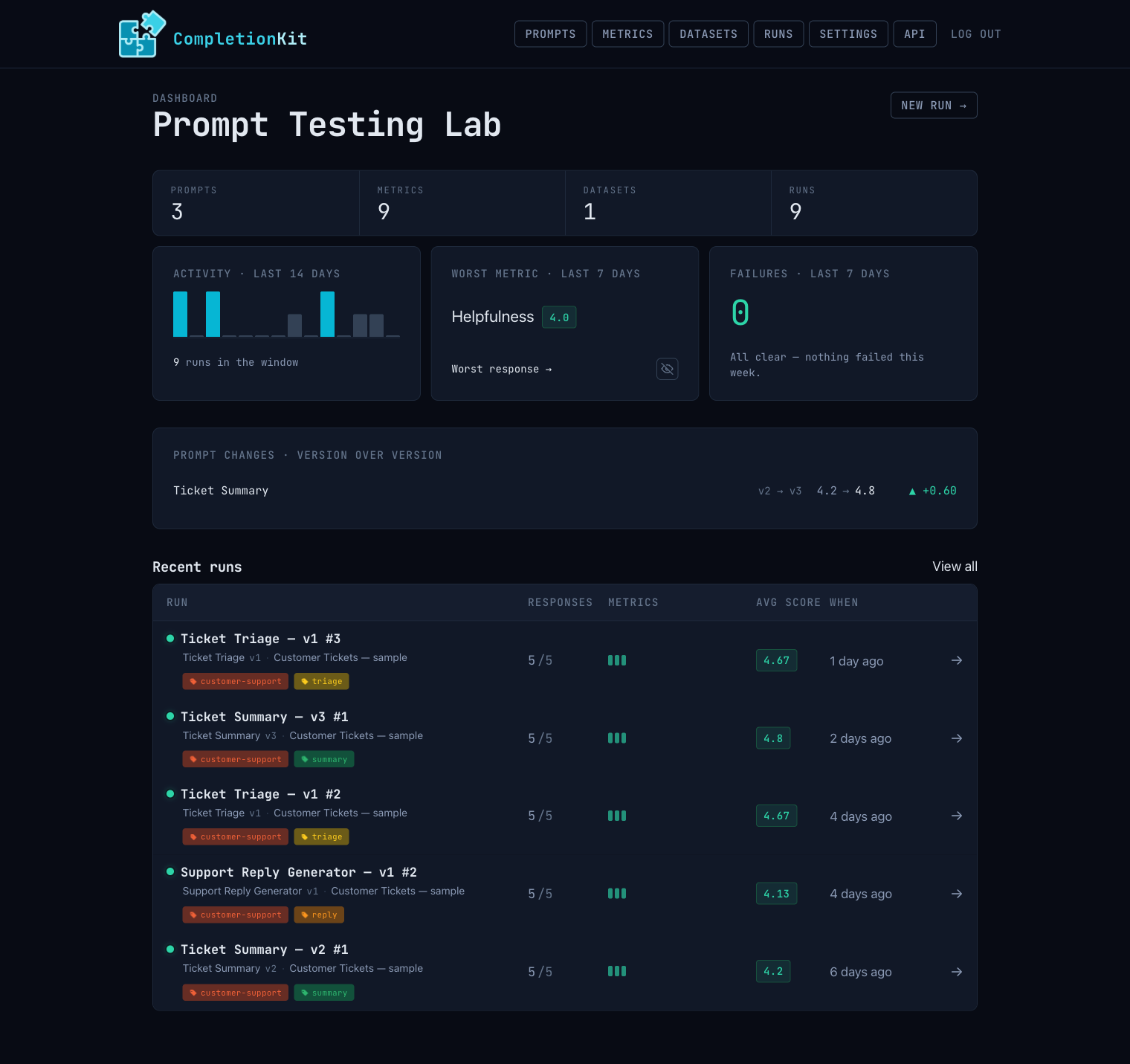
Run every prompt against real data. Score each output with an LLM judge against criteria you define. Change anything: the prompt, the model, the temperature, the dataset. Re-run and see exactly what got better and what broke. When the scores tell you something's off, CompletionKit suggests an improved prompt based on the judge's actual feedback on your runs. You inspect the diff, apply it as a new version, and verify the improvement.
It's the difference between "this prompt seems to work" and "this prompt scores 4.3 out of 5 across 200 inputs, up from 3.8 last version."
Start on completionkit.com → | RubyGems
Just want to use it? CompletionKit Cloud is the same engine, fully hosted — zero install, no Rails ops, plans at completionkit.com/pricing.
Three ways to run it
Same engine, same UI, same REST API and MCP server — pick the deployment that fits. The first two are stack-agnostic: you run CompletionKit as a product and talk to it over HTTP and MCP, whatever language your own app is written in. The third is for teams already building on Rails.
1. Hosted — completionkit.com (recommended)
The fastest path. Sign up and you're running on the same engine you'd self-host, without touching a Rails app. No db:migrate, no Puma, no Solid Queue, no provider key management — multi-tenant workspaces, your team logs in, you go. Plans at completionkit.com/pricing.
2. Self-hosted — the bundled standalone app
Run it on your own infra as a self-contained product. There's nothing to integrate and no Ruby to write — once it's up, you drive everything through the web UI, the REST API, and the MCP server, from whatever stack your own app is built in. It needs Postgres and a host that can run the app (Fly, Render, Heroku, Docker, …).
git clone https://github.com/homemade-software-inc/completion-kit.git
cd completion-kit/standalone
bundle install
bin/rails completion_kit:install:migrations
bin/rails db:migrate
Run both a web server and a Solid Queue worker. In two terminals:
bin/rails serverbin/jobsOr with foreman in one terminal: foreman start -f Procfile.dev.
Visit http://localhost:3000. Add a provider credential (Settings), create a prompt, upload a CSV dataset, and run it. See Deploying self-hosted for the production-env setup.
3. Rails engine — mount into your existing Rails app
gem "completion-kit"bin/rails generate completion_kit:install
bin/rails db:migrateThe engine mounts at /completion_kit. Generate / judge flows enqueue Active Job jobs (CompletionKit::GenerateRowJob, CompletionKit::JudgeReviewJob, CompletionKit::RunCompletionCheckJob), so your host app needs an Active Job adapter that actually processes them — Solid Queue, Sidekiq, GoodJob, etc. The :async adapter is not suitable for production: it runs jobs in the web Puma's thread pool with no durability and no retry, and a long LLM call will block request handling.
Host-app layout integration. If your host app overrides the engine layout (e.g. layout "application" on engine controllers, or rendering engine views inside your own shell), include both the engine's stylesheet and JavaScript in that layout:
<%= stylesheet_link_tag "completion_kit/application", media: "all" %>
<%= javascript_include_tag "completion_kit/application", defer: true, nonce: true %>
Without the JavaScript include, in-page behaviours silently fail: clickable table rows, dialogs, copy buttons, the API token reveal, the run form, live run status, live tag-breadcrumb updates, relative-time ticking, CSV row hover-expand, model-refresh progress, focus-first-error, and local-time formatting.
Content Security Policy. The engine's pages have no inline event handlers or inline scripts, and the engine layout puts the request nonce on its script tags, so the pages work under a nonce-based script-src. The views still use inline style attributes, so leave style-src out of the nonce directives and allow 'unsafe-inline' there for now.
Use a nonce that lasts the whole session, not a fresh random one per request. Turbo Drive re-creates the scripts in each new page body with the nonce from the csp-nonce meta tag, but the browser keeps enforcing the policy header of the first page it loaded, so a per-request nonce blocks nonce scripts after the first Drive visit.
Keep a random nonce in the session, and skip it for API controllers so cookie-less API and MCP calls get no session cookie, as the example below does. The Rails default, ->(request) { request.session.id.to_s }, also lasts the session, but it is empty on a brand-new visitor's first response, so a policy that admits scripts only by nonce blocks that first page's scripts until the session exists.
Rails.application.configure do
  config.content_security_policy do |policy|
    policy.default_src :self
    policy.script_src  :self
    policy.style_src   :self, :unsafe_inline
  end

  config.content_security_policy_nonce_generator = lambda do |request|
    next if request.controller_instance.is_a?(ActionController::API)

    request.session[:csp_nonce] ||= SecureRandom.base64(16)
  end
  config.content_security_policy_nonce_directives = %w(script-src)
end
Providers
CompletionKit discovers available models from each provider's API automatically.
| Provider | Env vars | What it covers |
|---|---|---|
| OpenAI | OPENAI_API_KEY |
GPT-5, GPT-4.1, GPT-4o, etc. |
| Anthropic | ANTHROPIC_API_KEY |
Claude Opus, Sonnet, Haiku |
| Ollama / local endpoint |
OLLAMA_API_ENDPOINT (default: http://localhost:11434/v1), OLLAMA_API_KEY (optional) |
Any model you've ollama pull-ed, or any OpenAI-compatible local server (vLLM, LM Studio, llama.cpp) |
| OpenRouter | OPENROUTER_API_KEY |
100+ models from 30+ providers through one API key |
| Azure AI Foundry | No env var — add via the Providers UI / a ProviderCredential (api_key + api_endpoint required, api_version optional) |
Azure OpenAI deployments and Foundry projects |
Set these as environment variables or configure them in the generated initializer. You can also add provider credentials through the web UI under Settings.
The Ollama key from OLLAMA_API_KEY or config.ollama_api_key goes only to the Ollama endpoint from OLLAMA_API_ENDPOINT or config.ollama_api_endpoint, or to http://localhost:11434/v1 when neither is set and config.allow_loopback_endpoints is on, which is the default. A provider credential with no key of its own gets that key only while it points at that same endpoint. Point it anywhere else and CompletionKit sends no key, so store the key on the credential itself. A key stored on a credential always goes to that credential's endpoint. Two endpoints match when their scheme, host, port and path match. The case of the scheme and host, a default port written out, a trailing slash and a trailing /v1 make no difference. A blank stored key counts as no key.
Encryption
Provider API keys are encrypted at rest using Active Record encryption. You need three encryption keys configured before the app will boot in production.
Generate them:
bin/rails db:encryption:initThen set them as environment variables:
COMPLETION_KIT_ENCRYPTION_PRIMARY_KEY=<generated value>
COMPLETION_KIT_ENCRYPTION_DETERMINISTIC_KEY=<generated value>
COMPLETION_KIT_ENCRYPTION_KEY_DERIVATION_SALT=<generated value>
Or add them to config/credentials.yml.enc under active_record_encryption. In development, the standalone app uses built-in fallback values so you can skip this step locally.
Authentication
CompletionKit requires authentication in any deployed environment. In development and test, routes are open by default (with a log warning); every other environment returns 403 until auth is configured.
Basic Auth (recommended for simple setups)
CompletionKit.configure do |c|
  c.username = "admin"
  c.password = ENV["COMPLETION_KIT_PASSWORD"]
end
Custom Auth (Devise, etc.)
CompletionKit.configure do |c|
  c.auth_strategy = ->(controller) { controller.authenticate_user! }
end
Only one mode can be active.
Reviewer name
When someone records a verdict on a judge's score in the web UI, CompletionKit saves it under a reviewer name. Each reviewer keeps one verdict per response and metric, so give every person their own name. Otherwise their verdicts overwrite each other. Set current_reviewer to a callable that receives the controller and returns the signed-in person's name:
CompletionKit.configure do |c|
  c.auth_strategy = ->(controller) { controller.authenticate_user! }
  c.current_reviewer = ->(controller) { controller.current_user&.email }
end
The callable must return a String or nil. Any other value, such as a user record, raises CompletionKit::ConfigurationError. If current_reviewer is unset or returns a blank value, verdicts are saved under username, or "operator" when no username is set. The web UI does not read the X-Remote-User header on its own. If a proxy in front of your app sets that header, pass it through:
CompletionKit.configure do |c|
  c.current_reviewer = ->(controller) { controller.request.headers["X-Remote-User"] }
end
Only use this header when a trusted proxy always overwrites it. Otherwise any client can send it and claim any reviewer name.
The REST API and the MCP server take the reviewer name from their own created_by parameter.
Rate limiting
The REST API, the MCP endpoint, and the web UI are rate limited per IP, per minute. The defaults are generous; tune them in the initializer:
CompletionKit.configure do |c|
  c.api_rate_limit = 120  # REST API + MCP, requests per minute (default 120)
  c.web_rate_limit = 300  # web UI, requests per minute (default 300)
end
Limiting uses Rails.cache. A shared cache store (Solid Cache, Redis) throttles accurately across multiple app instances; a per-process store still throttles each instance independently.
Input limits
Uploads, prompt templates, and regex check patterns have limits, so one large or hostile input cannot tie up a worker. Tune them in the initializer:
CompletionKit.configure do |c|
  c.max_upload_bytes = 25 * 1024 * 1024  # largest dataset CSV or import file (default 25 MB)
  c.max_template_bytes = 1024 * 1024     # largest prompt template (default 1 MB)
  c.regex_timeout = 1.0                  # seconds a regex check may spend matching one row (default 1.0)
end
A prompt whose template is over max_template_bytes fails validation when its template is saved. Prompts saved before a lower limit keep working until their template changes.
The first line of a dataset's CSV is its header row. A dataset fails validation when its CSV is saved with a header row that is blank or longer than 64 KB. The 64 KB limit is fixed, not a setting.
A dataset also fails validation when its CSV is saved with bytes that are not valid UTF-8, so export spreadsheets as UTF-8 CSV.
A regex check that runs past its time limit fails that row and says it timed out. The limit is regex_timeout, or your app's Regexp.timeout when that is shorter, so the engine never loosens a stricter limit your app set. The engine sets the limit on each pattern and never changes the process-wide Regexp.timeout. Set regex_timeout to a finite number of seconds of at least 0.001, or to nil to use only Regexp.timeout. Any other value, such as 0 or Float::INFINITY, raises an ArgumentError when the initializer runs.
How it works
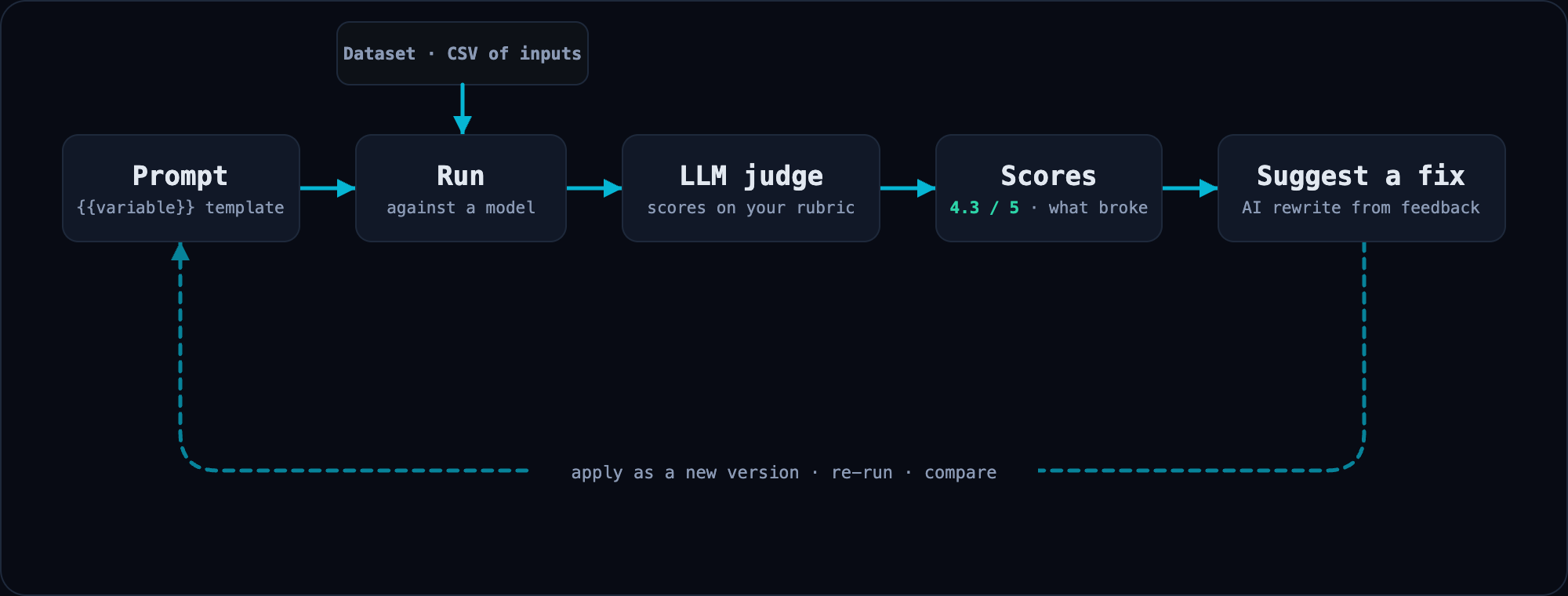
It's a loop. Each pass leaves you with a score you can compare against the last one.
-
Create a prompt with
{{variable}}placeholders - Upload a dataset. A CSV where column headers match the variable names.
- Run it against a model and score outputs with an LLM judge against criteria you define.
- Iterate. Change the prompt, the model, the temperature, or the dataset and re-run. CompletionKit versions your prompts so you can always compare against previous results.
- Get suggestions. When scores drop, ask CompletionKit for an AI-generated improvement. The suggestion is based on the judge's actual per-response feedback, not generic prompt-engineering advice. Inspect the diff and apply it as a new version.
Concepts
-
Prompt. A versioned template with
{{variable}}placeholders. Editing a prompt that's already been run creates a new version, so earlier results stay reproducible. - Dataset. A CSV of real inputs. Each row becomes one test case.
- Run. One execution of a prompt against a dataset. Captures every input (model, temperature, metrics) and stores all outputs and scores.
- Response. The model's output for one dataset row, with reviews attached.
- Metric. An evaluation dimension with a name, instruction, evaluation steps, and a 1-5 star scoring scale. The LLM judge uses this to score each response.
- Metric Group. A reusable group of metrics you can apply to a run as a set.
-
Tag. A domain label you can attach to prompts, runs, metrics, and datasets. Auto-assigned from a 10-color palette. Filter any index page by tag (
?tag[]=...). - Provider Credential. An API key for a model provider. Encrypted at rest, never returned through the API.
REST API
Every resource is accessible via a bearer-token JSON API:
CompletionKit.configure { |c| c.api_token = ENV["COMPLETION_KIT_API_TOKEN"] }curl -H "Authorization: Bearer $TOKEN" \
http://localhost:3000/completion_kit/api/v1/promptsVisit /completion_kit/api_reference in your running app for per-endpoint docs with copy-to-clipboard curl examples.
MCP server
CompletionKit runs a Model Context Protocol server at /completion_kit/mcp, exposing every resource as tools that MCP-aware clients (Claude Code, Cursor, etc.) can drive directly:
{
  "mcpServers": {
    "completion-kit": {
      "url": "https://your-app.com/completion_kit/mcp",
      "headers": { "Authorization": "Bearer YOUR_TOKEN" }
    }
  }
}
The in-app API reference page has install snippets you can copy straight into your MCP client config.
Deploying self-hosted
Any Rails-friendly host works (Fly, Heroku, Render, Docker, etc.). Point it at a Postgres instance via DATABASE_URL, set your provider env vars, and run cd standalone && bin/rails db:migrate on each deploy.
| Variable | Purpose | Default |
|---|---|---|
COMPLETION_KIT_API_TOKEN |
Bearer token for REST API and MCP | (none, API disabled) |
COMPLETION_KIT_USERNAME |
Web UI login username | admin |
COMPLETION_KIT_PASSWORD |
Web UI login password | (none, open in dev) |
You also need the three COMPLETION_KIT_ENCRYPTION_* keys from the Encryption section above.
When the gem ships a new migration, install it locally and commit before pushing:
cd standalone
bin/rails completion_kit:install:migrations
bin/rails db:migrate
git add db/migrate/ && git commit -m "install new engine migration"
Docker
The standalone app ships a Dockerfile, so you can self-host it without a Ruby toolchain on the host. Build with the repository root as the context — the app depends on the engine source alongside it:
docker build -f standalone/Dockerfile -t completion-kit .CompletionKit needs a Rails secret (SECRET_KEY_BASE) and three Active Record encryption keys. With Docker there's no Rails toolchain on the host to run bin/rails db:encryption:init, so generate them with openssl. Generate them once and keep them stable — if the encryption keys change, provider credentials already stored in the database can no longer be decrypted. Write everything to an env file:
cat > completion-kit.env <<EOF
DATABASE_URL=postgres://user:pass@host/completionkit
SECRET_KEY_BASE=$(openssl rand -hex 64)
COMPLETION_KIT_ENCRYPTION_PRIMARY_KEY=$(openssl rand -hex 32)
COMPLETION_KIT_ENCRYPTION_DETERMINISTIC_KEY=$(openssl rand -hex 32)
COMPLETION_KIT_ENCRYPTION_KEY_DERIVATION_SALT=$(openssl rand -hex 32)
EOF
openssl rand runs as the file is written, so each line gets a real random value. Keep completion-kit.env out of version control and back it up somewhere safe.
Run the web process and a job worker from the same image, both pointed at that file:
docker run -d -p 3000:3000 --env-file completion-kit.env completion-kit
docker run -d --env-file completion-kit.env completion-kit ./bin/jobs
Both processes must share the same SECRET_KEY_BASE and encryption keys — the single env file guarantees that. The web container runs db:prepare on boot, so migrations apply on first start and on every deploy.
Multi-tenant host apps (advanced)
For hosts that mount CompletionKit in a multi-tenant app, two optional hooks scope engine records per tenant without forking the engine:
CompletionKit.configure do |config|
  config.tenant_scope = -> {
    org = Current.organization&.id
    org ? where(organization_id: org) : where("1=0")
  }
  config.tenant_scope_columns = [:organization_id]
end
tenant_scope runs as each engine model's default_scope (use unscoped to bypass). tenant_scope_columns is appended to every engine uniqueness validation. Adding the tenant columns and composite unique indexes lives in your host migrations. Both defaults (nil, []) are no-ops. The completion_kit:mark_interrupted_runs_failed rake task bypasses tenant_scope and marks in-flight runs in every tenant, so a host that also enforces tenancy in the database, for example with row-level security, must run it as a database role that can see every tenant's rows.
Custom model endpoints and CSV imports by URL may reach the server's own loopback interface by default, so a local Ollama works out of the box. If the people using the engine should not reach services on the app server itself, set config.allow_loopback_endpoints = false. Private, link-local and reserved addresses are always refused.
One hook lets a host apply its own display rule everywhere the engine lists, counts, or traverses runs, without overriding controllers or views:
CompletionKit.configure do |config|
  config.runs_display_scope = -> { where(created_at: 90.days.ago..) }
  config.runs_display_footer_partial = "runs/display_notice"
end
runs_display_scope is a callable evaluated against a Run relation, in the same bare-where style as tenant_scope (it runs via instance_exec, so write it zero-arg with the relation as self, like a Rails scope lambda). It must return a relation: a callable that returns nil or anything non-chainable raises when a list renders. The engine applies it through Run.display_scoped at every run list and count it owns (the runs index, prompt and dataset show pages, the compare picker, new-run tag defaults, the v1 API index and its X-Total-Count, the MCP runs_list tool, the dashboard and API reference recent-runs panels, the dashboard "Runs" stat-card count, and provider-credential usage stats) and through Run.visible_run_ids for child records that traverse runs (the metric trust-panel sample and the agreement examples shown on a metric page). Use it for a list-only display rule rather than a global default_scope, which would null Run associations everywhere they are traversed.
Deliberately exempt, because they must still see every run: id-addressed single-run lookups (runs#show, the MCP runs_get tool, the v1 API show), delete-confirmation cascade counts, the auto-generated run-name counter, the dashboard's stat-card gate (it keys off the unscoped run total so a workspace whose runs the display scope excludes entirely still sees its activity cards rather than a blank dashboard), and the judge few-shot seeding that learns from corrected examples even on runs the display scope excludes.
runs_display_footer_partial names a partial rendered below the runs list on the dashboard, the index, and the prompt and dataset show pages; it receives the shown runs as a runs local. When the display scope excludes every run one of those surfaces would list, the surface says "No runs to show." and the footer partial renders beneath it. The engine cannot know why your scope excludes runs, so use the partial to explain your display rule: your host owns that rule in runs_display_scope and is the only side that can describe or count what it left out. Both default to nil (no-ops), leaving standalone behaviour unchanged.
Contributing
See CONTRIBUTING.md for development setup, testing, and pull request guidelines.
License
CompletionKit 0.3.0 and later are licensed under the Business Source License 1.1. You may use CompletionKit freely for any purpose, including production, except to offer it (or a derivative) to third parties as a hosted or managed service whose primary value is CompletionKit itself. Three years after each release, that version automatically re-licenses to GPL-3.
CompletionKit 0.2.x and earlier remain available under the MIT License.
For alternative licensing, contact hello@homemade.software.